Whether you’re keeping a new puppy out of the kitchen, blocking a senior dog from the stairs, or giving your cats a dog-free room, an indoor dog fence is a physical barrier that solves a specific spatial problem without training, electronics, or collars. The right indoor dog gate restricts your dog’s access to designated areas instantly, using pressure, wall anchors, or freestanding panels.
This guide covers every type of indoor dog fence, how to choose the right one, and what features actually matter — so you’re not guessing at the hardware store.
Types of Indoor Dog Fence
The market divides indoor dog barriers into several distinct categories. Understanding each type before you shop makes the choice much simpler.
1. Pressure-Mounted Gates
Pressure-mounted gates use a spring tension system to wedge against both sides of a door frame. No drilling required — you twist a knob until the gate presses firmly against the frame, and friction holds it in place. These are the most popular type of indoor dog gate because they’re quick to install, easy to move between doorways, and leave no permanent wall damage.
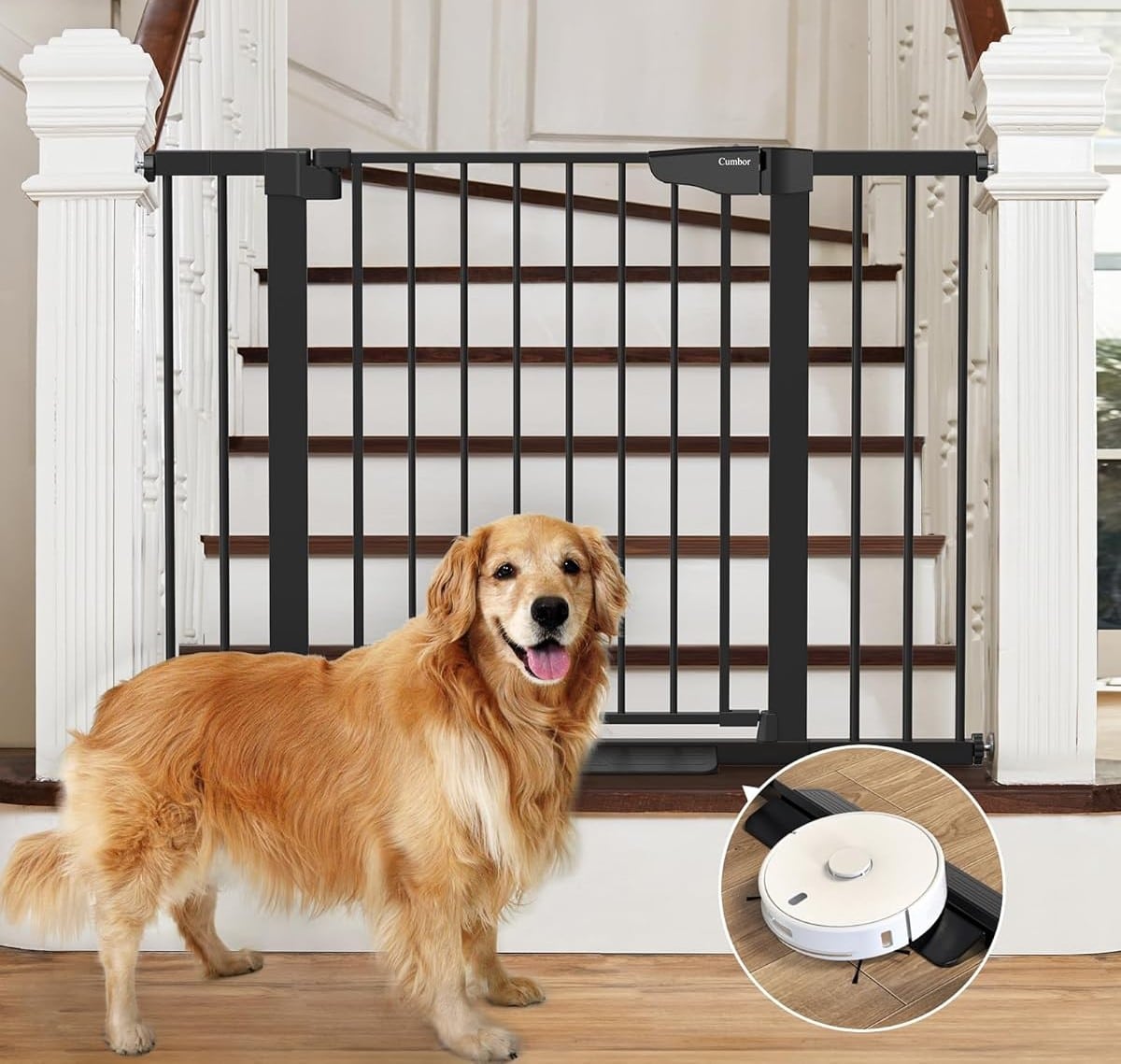
One critical safety note: pressure-mounted gates should never be used at the top of stairs. A dog — or a child — applying enough outward force can push the gate free from the frame. At the top of a staircase, only a wall-mounted gate is safe.
2. Wall-Mounted Gates
Wall-mounted gates screw directly into wall studs or use heavy-duty anchors. They don’t rely on tension, which makes them significantly more secure than pressure mounts. A determined 80-pound dog can eventually displace a pressure-mounted gate; a properly installed wall-mounted gate won’t budge.
Wall-mounted gates are the right choice for:
- Top of stairs — the only safe option here
- Large or powerful dog breeds
- Dogs that push, lean, or charge at barriers
- Permanent installations you don’t plan to move
The trade-off is installation effort and minor wall damage. You’ll have screw holes to patch when you remove the gate, but that’s fully repairable with spackling and a touch of paint.
3. Freestanding Barriers
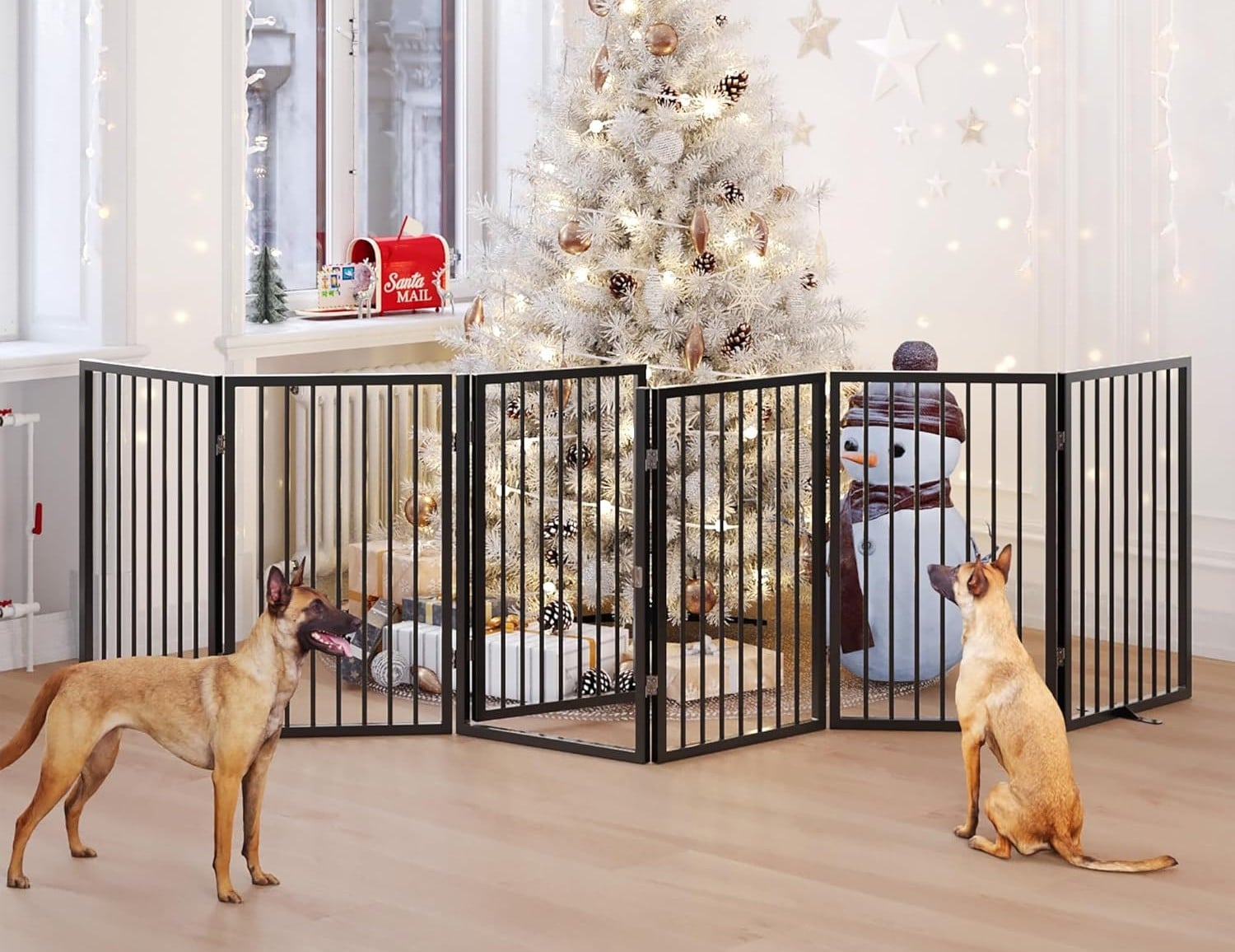
Freestanding barriers stand on their own without attaching to walls. They’re built as hinged panels that fold into a wide, self-supporting barrier — similar to an accordion room divider. Their main advantage is flexibility: place a freestanding dog room divider in the middle of an open room, across a wide hallway, or anywhere there’s no frame to mount against.
The limitation is security. A dog that learns to push a freestanding barrier can often topple it on hard floors. They work best for smaller or calmer dogs, or situations where you need a visual deterrent more than a rigid physical barrier.
4. Walk-Through Gates vs. Step-Over Gates
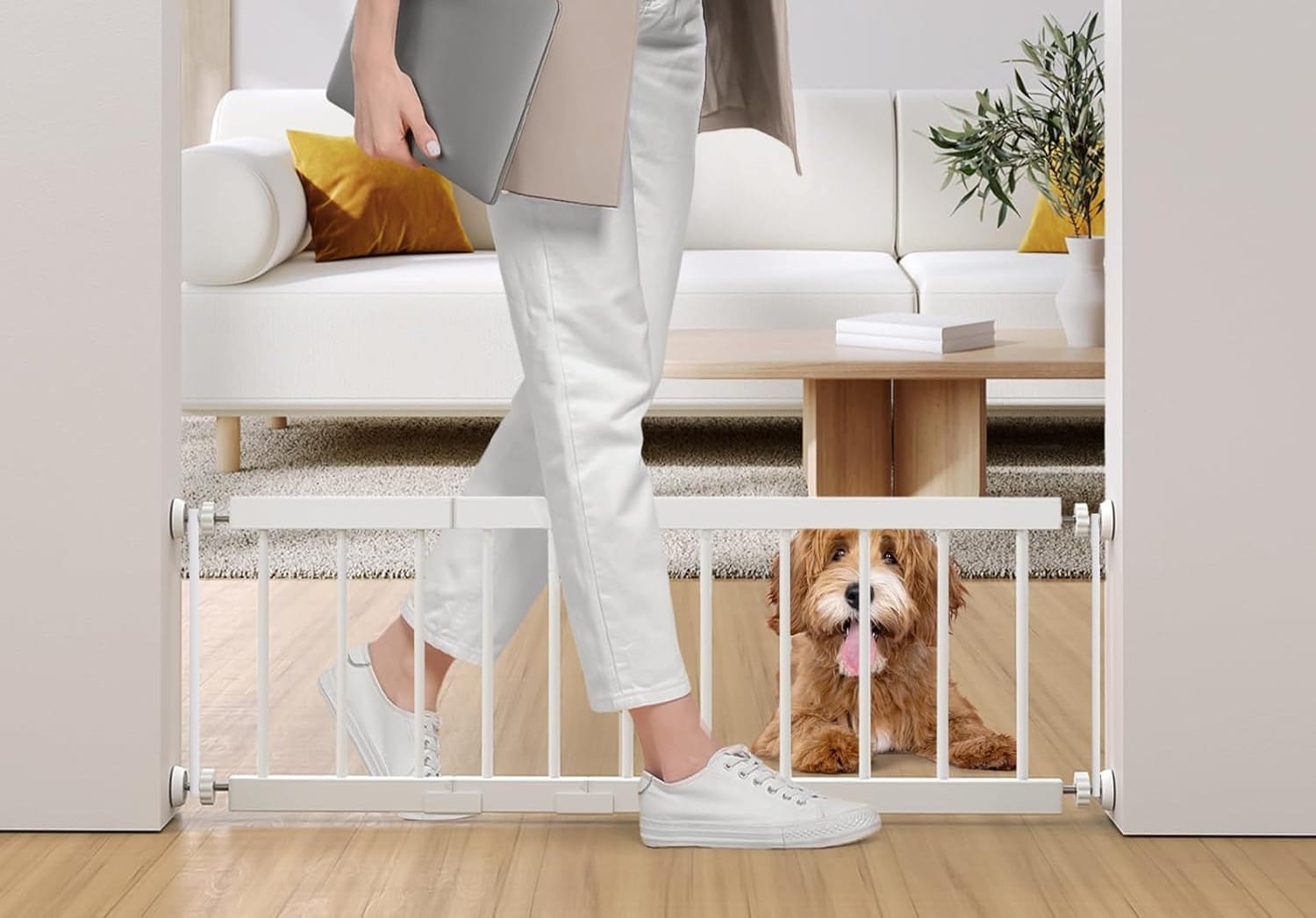
Walk-through gates have a hinged door that swings open so you pass through without lifting your legs. These suit households where people pass frequently — especially anyone carrying a baby, groceries, or laundry, or anyone with limited mobility.
Step-over gates have no door; you lift your leg and step over the top rail. They’re more secure because there’s no moving latch mechanism a clever dog might nose open. Use them in low-traffic utility areas where adults pass through with hands free.
5. Extra-Wide and Extra-Tall Gates
Standard gates cover 24 to 36 inches wide. Extra-wide gates with extension panels span up to 60 inches — necessary for wide hallways or open kitchen entrances. Standard height is 29 to 32 inches; tall gates reach 36 to 41 inches for large breeds or athletic jumpers. If your dog has already cleared a standard gate, upgrading height is the direct fix.
6. Exercise Pens Used Indoors
An exercise pen — ex-pen — is a set of 6 to 8 modular wire panels that connect into a large freestanding enclosure. Used indoors, they create a contained zone rather than simply blocking a doorway. Indoor use cases include:
- Creating a puppy zone in a living room or kitchen
- Confining a dog recovering from surgery
- Containing a dog during gatherings when exterior doors open frequently
- Setting up a safe enclosure in unfamiliar environments like hotel rooms
Panels are reconfigurable into square, rectangular, or irregular shapes to fit your floor plan, and most fold flat for storage.
How to Choose the Right Indoor Dog Fence
The right indoor dog gate is determined by location first, then your dog’s size and behavior, then the dimensions of your opening.
Location Determines the Type
| Location | Correct Gate Type |
|---|---|
| Top of stairs | Wall-mounted only — pressure mounts are unsafe here |
| Bottom of stairs | Pressure-mounted or wall-mounted |
| Standard doorway | Pressure-mounted (easiest) or wall-mounted |
| Wide opening with no frame | Extra-wide gate with extensions, or freestanding barrier |
| Open-plan room | Freestanding panels or exercise pen |
| Post-surgery containment | Exercise pen configured as an enclosure |
Dog Size and Strength
Small dogs under 25 pounds are contained by most pressure-mounted gates. Medium dogs (25 to 60 pounds) do fine with quality pressure mounts in standard doorways, though high-energy or pushy dogs may warrant wall-mounted options. Large dogs over 60 pounds, and powerful breeds like Rottweilers, German Shepherds, or Huskies, should have wall-mounted gates wherever security matters — repeated impacts from large dogs loosen pressure mount tension over time.
Measuring the Opening
Measure at the narrowest point — typically the door frame, not the wall opening behind it. Check whether deep baseboards reduce usable mounting depth. If your opening exceeds the gate’s maximum span (usually 36 to 38 inches without accessories), confirm whether extension panels are sold for that model and what sizes are available. Some brands use proprietary extensions; others offer universal sizing.
Walk-Through vs. Step-Over for Your Household
If anyone in your household is pregnant, elderly, physically limited, or regularly carries items through the gate, choose walk-through. Asking someone to step over a 30-inch rail multiple times daily creates its own fall hazard. Step-over gates suit low-traffic utility locations where security is the priority and hands are always free.
Material and Chew Resistance
Chewers will target wood and plastic frames first. Welded steel or aluminum construction resists chewing. Avoid gates with plastic corner connectors if your dog destroys barriers — those joints fail before the frame itself. Mesh fabric gates are lightweight and travel-friendly but offer zero chew resistance; they suit dogs that accept barriers without testing them physically.
Aesthetics
Matte black metal suits most contemporary homes. Wood-finish gates with metal hardware work in traditional interiors. White or ivory plastic blends into lighter walls. Utility areas like garages or laundry rooms don’t require aesthetic consideration — use whatever provides the right security at the lowest cost.
Read more: Wireless dog fence guide
Indoor Dog Fence by Use Case
Puppy Containment Zone
A new puppy needs a defined safe space, not access to the whole house. An exercise pen in the corner of a room creates a puppy zone large enough for a crate, water bowl, and play area without exposing the puppy to furniture, electrical cords, or exits. Minimum 6 by 6 feet for a medium-breed puppy. Place the crate inside with the door open so the puppy can rest voluntarily. As the puppy earns trust, the pen can be reduced or removed. A pressure-mounted gate at the kitchen entry adds a second layer of restriction during supervised time outside the pen.
Stair Safety for Senior Dogs
Older dogs with arthritis, hip dysplasia, or neurological conditions frequently injure themselves on stairs — falls going down are the greatest risk. Install a wall-mounted gate at the top of the stairs, and a second gate at the bottom to prevent unsupervised climbing. This two-gate approach matters most overnight. Always choose walk-through design for stair gates — step-over gates on a stairway landing create their own fall hazard for people.
Kitchen Restriction
A pressure-mounted gate handles most kitchen doorways efficiently. Measure carefully — kitchen entrances in older homes are frequently non-standard widths. If the kitchen opens into a wide dining area without a frame, you’ll need an extra-wide gate with extensions or a freestanding barrier spanning the full gap. Consider a gate with a built-in cat flap if cats need kitchen access for food or water while the dog stays out.
Room Separation for Multi-Pet Households
A gate with a built-in small pet door lets cats pass freely while physically blocking dogs. Place the cat’s litter box, food, and a resting area on the protected side. The indoor pet fence gives cats agency — they can retreat from the dog at will, which reduces inter-animal stress significantly. Check that the pet flap sits at floor level; elevated flaps create difficulty for older cats with reduced jumping ability.
Post-Surgery or Injury Recovery
Veterinarians frequently instruct owners to restrict movement after orthopedic surgery or significant injuries. An exercise pen configured as an indoor enclosure gives more space than a crate alone — enough to stand, turn around, and lie stretched out — while preventing running, jumping, or stair access. More space means less stress, which supports healing. Add non-slip mats on hard floors and leave the crate door open inside the pen for voluntary rest.
Installation and Placement Tips
Setting Tension on Pressure-Mounted Gates
Too loose and the gate tips or slides; too tight and the pressure pads mark or damage drywall. The right tension holds firm under moderate pushing force without leaving visible wall indentations. Check tension again after the first week — pressure mounts often settle slightly during initial use. On carpeted floors, some models need carpet feet extensions to ensure the bottom rail contacts the surface. On hard floors, rubber feet prevent lateral sliding.
Wall-Mounted Gate Installation
Use a stud finder before drilling. Mounting into drywall alone fails over time under large dog impact. Where studs aren’t where you need them, use toggle bolts or heavy-duty anchors rated for at least three times the expected load. Install the hinge-side bracket first, level it, then install the latch-side bracket at the correct width. Test the gate fully assembled before applying final torque. When removing the gate, fill holes with spackling, sand smooth, and touch up the paint.
Stabilizing Freestanding Barriers
Non-slip furniture pads under each foot or small sandbags on the dog’s side of the base reduce tipping. If the barrier hinges at the center, open the hinge fully — a partially collapsed barrier tips far more easily than one at its full stable angle. Some manufacturers sell purpose-built weighted foot attachments for their freestanding models.
Gates with Pet Doors
Check the flap opening dimensions against your smallest adult cat’s shoulder width — it should be comfortably wider than the cat’s body. Introduce a reluctant cat to the flap by propping it fully open for a few days, then gradually lowering it to operation. Elderly cats with arthritis may need a small step stool on the approach side to reduce crouching effort.
Common Measurement Mistake
The most frequent purchasing error is measuring only opening width while ignoring frame depth and floor type. Deep baseboards can reduce usable mounting width by 2 to 3 inches. Carpeted floors raise the gate’s effective bottom clearance, which matters for dogs that try to squeeze under. Measure at floor level and at rail height, not just at eye level where the frame looks clean.
Top Features Worth Paying For
One-Handed Operation
If you carry anything through the gate regularly, one-handed operation is essential. The latch should disengage with a thumb or single finger while your arm is full. Some double-lock gates require two hands to open — great for security, frustrating if one hand is always occupied. Check the specific latch mechanism before buying.
Auto-Close Mechanism
An auto-close gate swings shut and latches automatically after each pass-through. This prevents the most common failure mode: someone forgets to close it and the dog walks through. Households with young children are especially prone to this. Auto-close adds cost but eliminates a genuinely frequent problem.
Double-Locking Latch
Some dogs learn to nose or paw a standard single-action latch open. A double-lock requires two distinct movements — typically a lift combined with a push, or a squeeze paired with a pull — that dogs cannot replicate. If your dog has already defeated one gate by working the latch, a double-lock model is the correct next step.
Height Appropriate for Your Dog
Standard gates at 29 to 32 inches suit most dogs up to 50 pounds. Taller or more athletic dogs may clear standard height with a running approach. Tall gates at 36 to 41 inches address this directly. If your dog has already jumped over one gate, upgrade the height — replacing it with the same size will produce the same result.
Extension Compatibility
Before buying, confirm whether extension panels are sold for that model, what sizes are available, and whether they’re brand-proprietary. Some manufacturers offer extensions from 6 to 24 inches; others offer a single fixed size. Non-standard opening widths make extension availability a deciding factor.
Easy Removal for Cleaning
Gates accumulate dog hair in hinges and mud on lower rails. Gates that lift off mounting brackets in one motion, or fold flat for rinsing, are substantially easier to maintain over months and years of daily use. Worth factoring into the purchase decision, not just the initial install.
Frequently Asked Questions
What is the best indoor dog fence for large dogs?
For large dogs, a wall-mounted gate is the most reliable option. Look for models marketed specifically for large breeds — these use heavier-gauge steel tubing, reinforced hinges, and mounting hardware engineered for repeated high-force impact. Confirm the gate is at least 36 inches tall. Verify the manufacturer’s weight and breed-size ratings, as some products use large-dog marketing without the construction to support it.
Can I use a baby gate as an indoor dog fence?
Yes — many baby gates and dog gates are identical products sold under different marketing. The specifications are the same: mounting type, opening width, height, and latch security. A baby gate rated for a toddler’s force is generally adequate for small to medium dogs. For large or powerful dogs, verify force ratings specifically, since some baby-focused gates use lighter hardware than what large dogs require over sustained use.
How do I stop my dog from jumping over indoor gates?
Upgrade to a taller gate — 36 to 41 inches. Some systems also sell vertical extension panels that attach to the top of the gate for additional height. For a small number of highly athletic dogs, consistent boundary training reinforces the physical barrier. Height and behavioral expectations work better together than either does alone.
What indoor dog fence requires no drilling?
Pressure-mounted gates require no drilling — they use spring tension against the door frame. Freestanding barriers require no wall attachment at all. For wide openings, a freestanding multi-panel barrier is the no-drill solution. The trade-off is reduced security: neither type is as strong as a wall-mounted gate, and pressure mounts must never be used at the top of stairs regardless of convenience.
How do I keep my dog out of one room without a door?
If the room has a doorway but no door installed, a pressure-mounted or wall-mounted gate fills that opening exactly. If the room opens into another space without a defined frame, use an extra-wide gate with extensions spanning the full gap, or a freestanding multi-panel barrier across the opening. For very wide or architecturally open spaces, an exercise pen configured in a straight line creates an effective indoor dog barrier without walls on either side.
Are freestanding dog gates safe?
Freestanding dog gates are safe for most small and medium dogs that respect barriers without persistently pushing on them. They’re not safe for large dogs that charge or lean into barriers, and they should never be used at the top of stairs. The core risk is displacement — a dog applies enough force, the gate moves, and the dog walks through. Non-slip foot pads and weighted bases improve stability, but a genuinely determined large dog will eventually move a freestanding barrier. Use wall-mounted gates wherever the consequence of a breakthrough is serious.
Conclusion
An indoor dog fence doesn’t require training, electronics, or ongoing management — it’s a physical solution to a spatial problem. Choose the mounting type based on location first: wall-mounted at the top of stairs, pressure-mounted everywhere else it applies. Size the gate for your dog’s height and your opening width. Invest in walk-through design if anyone in your household carries things or has mobility limitations, and add auto-close if you’ve found yourself forgetting to latch gates.
The difference between a gate that works reliably for years and one you replace twice isn’t usually price — it’s matching the gate type to the actual use case. Get the type and location right first, then look at features and finish. Measure the full opening before ordering, confirm extension availability for non-standard widths, and you’ll have a working indoor dog barrier installed in under an hour.
Looking for a high-tech item? Try GPS dog fence!
This post is for informational purposes only. Always follow the manufacturer’s installation instructions for any gate or barrier product. For stair safety involving children, consult current guidelines from relevant child safety organizations in your region. Product dimensions, load ratings, and installation requirements vary between manufacturers and individual models.