Your vet just told you your dog is “a little chunky” and to keep an eye on their weight. Your dog isn’t obese — but they’re heading there, and you want to get ahead of it. Weight control dog food is designed exactly for this situation: it keeps a borderline or weight-prone dog at a healthy weight without the drastic caloric cuts needed for active weight loss. The right weight management dog food gives your dog the same satisfying volume of food with fewer calories, so they feel full and you feel good about what you’re feeding them.
This isn’t about putting your dog on a crash diet. It’s about finding a sustainable way of eating that prevents the slow creep of pounds over months and years. Let’s break down how weight control food works, who actually needs it, what to look for on the label, and how to make the switch without your dog staging a hunger protest.
Quick Answer: Weight Control Dog Food
- Weight control dog food is for dogs at risk of gaining weight — not yet overweight, or maintaining after weight loss.
- It works by reducing caloric density, increasing fiber for satiety, and including L-carnitine to support lean muscle.
- Target crude fat of 8–12% DM and crude protein of 25%+ DM — look for “adult maintenance” on the AAFCO statement.
- Portion accuracy matters more than brand — use a kitchen scale, not a scoop, and count treat calories.
- Dogs with a Body Condition Score of 5–6 out of 9 are the sweet spot for weight control food; BCS 7+ usually needs an active weight loss formula instead.
Which Dogs Actually Need Weight Control Food?
Not every dog needs weight control food, but more dogs benefit from it than most owners realize. The key is knowing the risk factors before the scale tips — because once a dog carries extra weight for years, reversing it is much harder than preventing it in the first place.

Spayed and Neutered Dogs
Spaying and neutering reduces metabolic rate by roughly 20–30%. That’s a significant shift that happens almost overnight after surgery, and most owners don’t adjust food portions to compensate. A dog who was eating the right amount before their procedure is likely eating too much within weeks of recovery. The post-surgery window is one of the highest-risk periods for gradual weight gain. Many vets recommend transitioning to a weight management dog food within a few months of spay or neuter surgery, especially for breeds already prone to weight gain.
Age-Related Weight Gain in Senior Dogs
Dogs over age seven tend to become less active naturally. Their metabolism slows, their joints may ache enough to discourage long walks, and their lean muscle mass decreases — which lowers their baseline calorie burn. A senior dog who has always eaten the same food at the same portions may start gaining weight simply because their body has changed. Senior-specific weight control formulas address this by reducing calories while also adding joint-supporting ingredients like glucosamine and chondroitin.
Breed Predispositions
Some breeds are genetically wired to gain weight. This isn’t a training or willpower issue — it’s biology. Labrador Retrievers famously carry a mutation in the MC4R gene that reduces their sense of satiety. They literally feel less full than other dogs after the same meal. This is why Labs vacuum up every scrap of food as if they haven’t eaten in days — because from their perspective, they haven’t quite felt satisfied. Other breeds with documented weight predispositions include:
- Beagles — food-motivated to an extraordinary degree
- Cocker Spaniels — prone to weight gain after middle age
- Basset Hounds — low energy drives and a love of lounging
- Cavalier King Charles Spaniels — tend toward inactivity as they age
- Pugs — brachycephalic anatomy limits intense exercise
- Dachshunds — extra weight puts dangerous pressure on their long spines
If your dog is one of these breeds, starting on a healthy weight dog food proactively — before they’re overweight — is a reasonable choice even when they’re at a normal weight.
If you think your dog is overweight, explore weight loss dog food guide by VET
Lifestyle Factors
A dog’s activity level shifts throughout their life. An indoor-only dog who rarely gets more than a few short walks a day has different caloric needs than a dog who jogs with their owner every morning. Working dogs that have retired (former search and rescue dogs, police K9s, farm dogs) often experience significant weight gain when their activity drops but their food intake doesn’t. Dogs recovering from injury or surgery may spend weeks or months with restricted movement, which changes their caloric requirements substantially.
The Body Condition Score Sweet Spot
Body Condition Score (BCS) is the standard tool vets use to assess a dog’s weight relative to their frame — it’s more useful than a scale number alone because it accounts for different breed sizes. A BCS of 4–5 out of 9 is ideal. A score of 5–6 is the borderline zone where weight control food makes the most sense. At 5–6, your dog isn’t overweight enough to need a therapeutic weight loss diet, but they’re carrying just enough extra that action now prevents a much bigger problem later.
Note: If your dog scores 7 or above on a 9-point BCS scale, standard weight control food may not provide enough caloric restriction. Discuss a dedicated weight loss formula or veterinary therapeutic diet with your vet instead.
How Weight Control Dog Food Actually Works
Weight control dog food isn’t just regular food with smaller portions. The formulation itself is different in ways that make it possible for your dog to eat a satisfying amount while consuming fewer total calories. Understanding the mechanics helps you read labels intelligently instead of just grabbing the bag that says “lite.”
Reduced Caloric Density
The primary mechanism is simple: fewer calories per cup. A standard adult maintenance food might contain 380–420 calories per cup. A typical weight management dog food lands in the 280–340 calorie range per cup. That 80–100 calorie difference per cup adds up to a meaningful reduction over a day, especially for smaller dogs. Critically, the volume stays similar — your dog is still eating a full bowl, which matters both psychologically and physically for satiety.
Fiber Strategy: Feeling Full on Less
The fiber content in weight control foods is higher than in standard adult foods — usually 4–8% crude fiber compared to 2–4% in regular formulas. This isn’t filler. Specific fibers like beet pulp, chicory root, and pea fiber slow the digestive process, which delays stomach emptying and prolongs the sensation of fullness. Chicory root also acts as a prebiotic, supporting the gut bacteria that play a role in appetite regulation. The result is a dog who reaches the end of their meal feeling satisfied rather than immediately circling back to the bowl looking for more.
L-Carnitine: The Lean Muscle Protector
L-carnitine is an amino acid compound that helps the body transport fatty acids into cells to be burned for energy. When a dog’s caloric intake is reduced, there’s a risk that the body burns muscle protein for energy alongside fat — which is counterproductive because lean muscle mass is what keeps a dog’s metabolism healthy. L-carnitine helps shift the body’s preference toward burning fat for fuel while preserving lean muscle tissue. Most quality weight management dog food formulas include L-carnitine specifically for this reason. You’ll see it listed toward the bottom of the ingredient list (it’s effective in small amounts), but its presence is a sign that the formula was thoughtfully designed for weight management rather than just calorie-slashed.
Protein Ratio: Keeping Muscle During Caloric Restriction
One of the counterintuitive things about weight control food is that the protein percentage should stay high — or even increase relative to fat. High protein dog food serves two purposes: it supports lean muscle retention, and it’s more satiating than fat or carbohydrates on a calorie-per-calorie basis. A well-formulated weight control food maintains crude protein at 25% or higher on a dry matter basis while reducing fat to the 8–12% DM range. This is different from a blanket low-fat food, where the goal is purely to limit fat intake — here, the goal is a specific macro ratio that serves both weight and muscle goals.
By the Numbers: Regular Food vs. Weight Control Food
| Nutrient | Standard Adult Food | Weight Control Food |
|---|---|---|
| Calories per cup | 380–420 kcal | 280–340 kcal |
| Crude fat (DM) | 14–18% | 8–12% |
| Crude protein (DM) | 25–30% | 28–35% |
| Crude fiber | 2–4% | 4–8% |
| L-carnitine | Rarely included | Commonly included |
What to Look for on a Weight Control Dog Food Label
Pet food labels are a maze of percentages, marketing claims, and fine print. Here’s what actually matters when you’re evaluating a weight control dog food — and what each number tells you.
Calorie Content (kcal/cup)
The FDA requires pet food manufacturers to provide caloric content information, but it’s often buried. Look for the “Calorie Content” panel, which may appear on the back or side of the bag separately from the guaranteed analysis. For weight control purposes, target foods in the 280–340 kcal/cup range. Foods above 360 kcal/cup aren’t really providing meaningful caloric reduction compared to regular food. Some manufacturers publish calorie content only on their website — if you can’t find it on the bag, check online before buying.
Crude Fat Percentage
On the guaranteed analysis panel, look for crude fat in the 8–12% range on an as-fed basis (which is roughly equivalent to dry matter for dry kibble). This is the weight control range — reduced enough to lower caloric density meaningfully, but not so low that you’re into therapeutic low-fat territory (which is typically under 6–7% DM and reserved for conditions like pancreatitis or lymphangiectasia). If a food has 14%+ crude fat, it’s a standard adult food regardless of what the marketing says on the front of the bag.
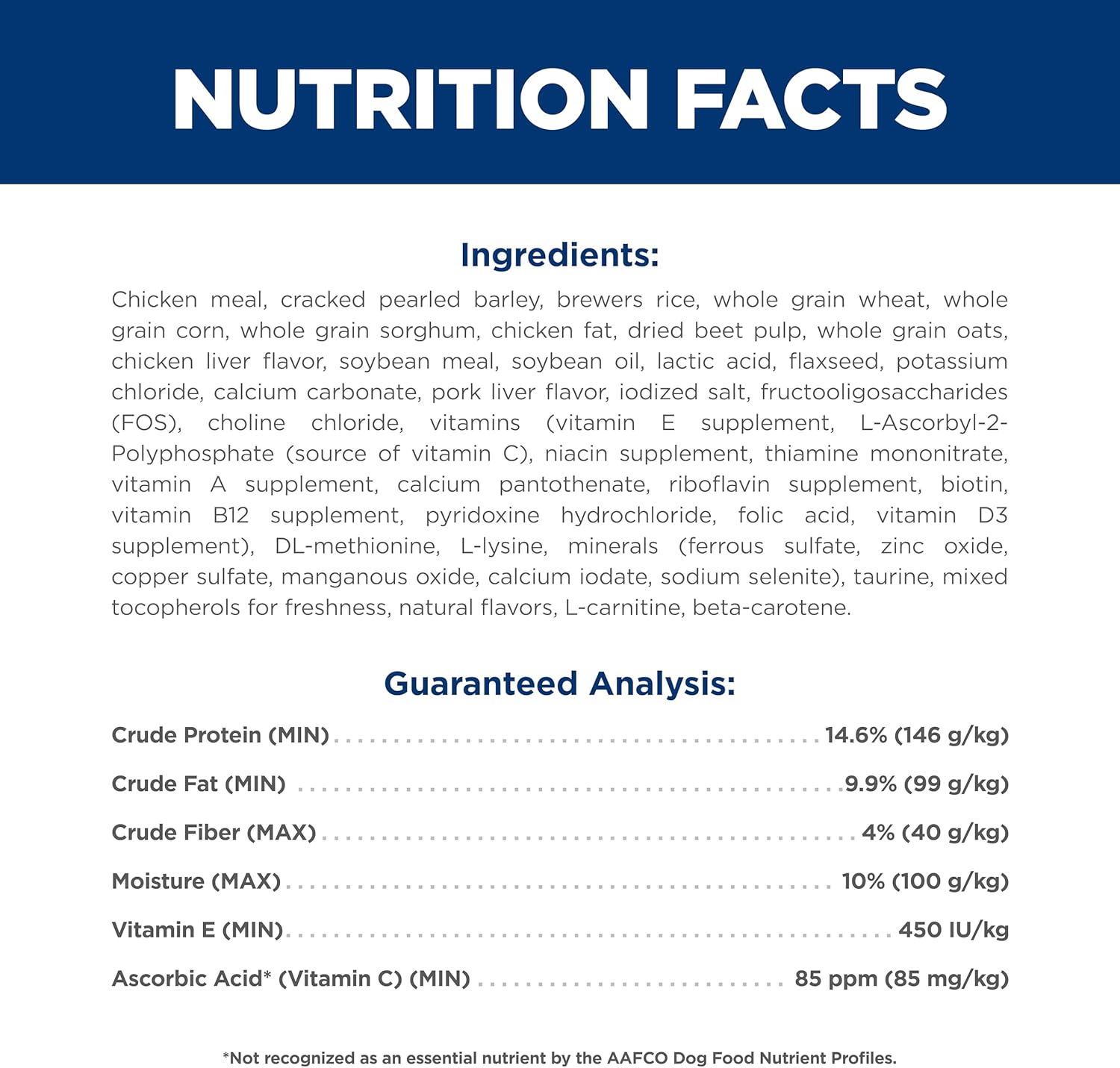
Crude Protein Percentage
Crude protein should not drop significantly in a quality weight control formula. Look for 25% or higher on the guaranteed analysis as-fed basis for dry food. If you see a weight control food where protein has dropped to 18–20%, the formulator cut calories by reducing protein rather than fat — which is the wrong trade-off for maintaining your dog’s lean body mass.
Fiber Percentage
The 4–8% crude fiber range is the sweet spot. Below 4%, there’s not much satiety benefit over regular food. Above 8–10%, some dogs experience loose stools, gas, or reduced nutrient absorption as a side effect. If your dog has a sensitive stomach, start at the lower end of this range and monitor stool quality during the transition.
L-Carnitine on the Ingredient List
Scan the ingredient list for “L-carnitine” or “carnitine.” It doesn’t need to be in the first ten ingredients — it’s effective at low concentrations — but its presence confirms the formula was designed with muscle preservation in mind rather than just calorie reduction.
AAFCO Statement
The AAFCO nutritional adequacy statement must say “adult maintenance” or “all life stages.” A weight control food that says “adult maintenance” is complete and balanced for adult dogs. Avoid any food that says only “for intermittent or supplemental feeding” — these are not complete diets and are not appropriate as a dog’s primary food. “All life stages” formulas also work for adult dogs, though they’re often formulated more generously since they need to support puppies and pregnant dogs too.
What “Lite” and “Reduced Calorie” Legally Mean
In the US, the Association of American Feed Control Officials (AAFCO) defines these terms specifically:
- “Lite” or “Light”: Must meet maximum calorie limits — for dry dog food, no more than 3,100 kcal/kg (roughly 388 kcal per cup at standard density). This is a regulated cap.
- “Reduced calorie” or “Less calories”: Must be at least 25% fewer calories than the product it’s being compared to. The comparison product must be named on the label.
- “Weight control,” “healthy weight,” “weight management”: These terms are NOT legally defined under AAFCO regulations. Any food can use these phrases regardless of caloric content. This is why you need to check the actual numbers rather than trusting the marketing language on the front of the bag.
Portion Control: The Part Most Owners Get Wrong
Switching to weight management food for dogs is only half the equation. The other half — the part that derails more weight management plans than any food choice — is portion accuracy. Even the best-formulated weight control food will cause weight gain if fed in excess.
Measuring Cup vs. Kitchen Scale
This one change makes more difference than most owners expect. A standard dry measuring cup scooped loosely versus packed down versus heaped can vary by 20–30%. Kibble density also varies between brands. A kitchen scale set to grams removes all of that variability. Weigh your dog’s daily ration once, note the gram amount, and repeat consistently. It adds thirty seconds to feeding time and significantly improves accuracy over months of feeding.
The Treat Math
The general rule is that treats should make up no more than 10% of a dog’s daily caloric intake. For a 1,096 kcal/day dog, that’s about 110 calories of treats — which sounds like a lot until you realize that a single commercial dog biscuit often contains 40–80 calories, and training sessions with small treats can easily add up to 50–100 calories without feeling like much. The fix isn’t to eliminate treats — it’s to count them. Note how many treats you give per day, look up their calorie content, and deduct that amount from your dog’s daily food portion.
Feeding Frequency and Free Feeding
Free feeding — leaving food out all day for a dog to eat at will — fails almost universally for weight-prone dogs. Dogs with a predisposition to weight gain will reliably overeat when food is always available. Two measured meals per day (morning and evening) gives you control over exactly how much your dog eats, allows you to monitor appetite as a health indicator, and creates clear meal events that are psychologically satisfying for most dogs.
Slow Feeders and Food Puzzles
Dogs who eat their meals in under two minutes often still feel hungry immediately after, even if they’ve eaten the right amount. Extending the eating experience by using a slow feeder bowl or a food-dispensing puzzle toy gives the satiety hormones more time to signal the brain that a meal has occurred. Research in both dogs and humans suggests that slower eating is associated with lower total calorie consumption and greater meal satisfaction. This is a simple, low-cost tool that makes a real difference for dogs who act ravenous right after finishing a correctly portioned meal.
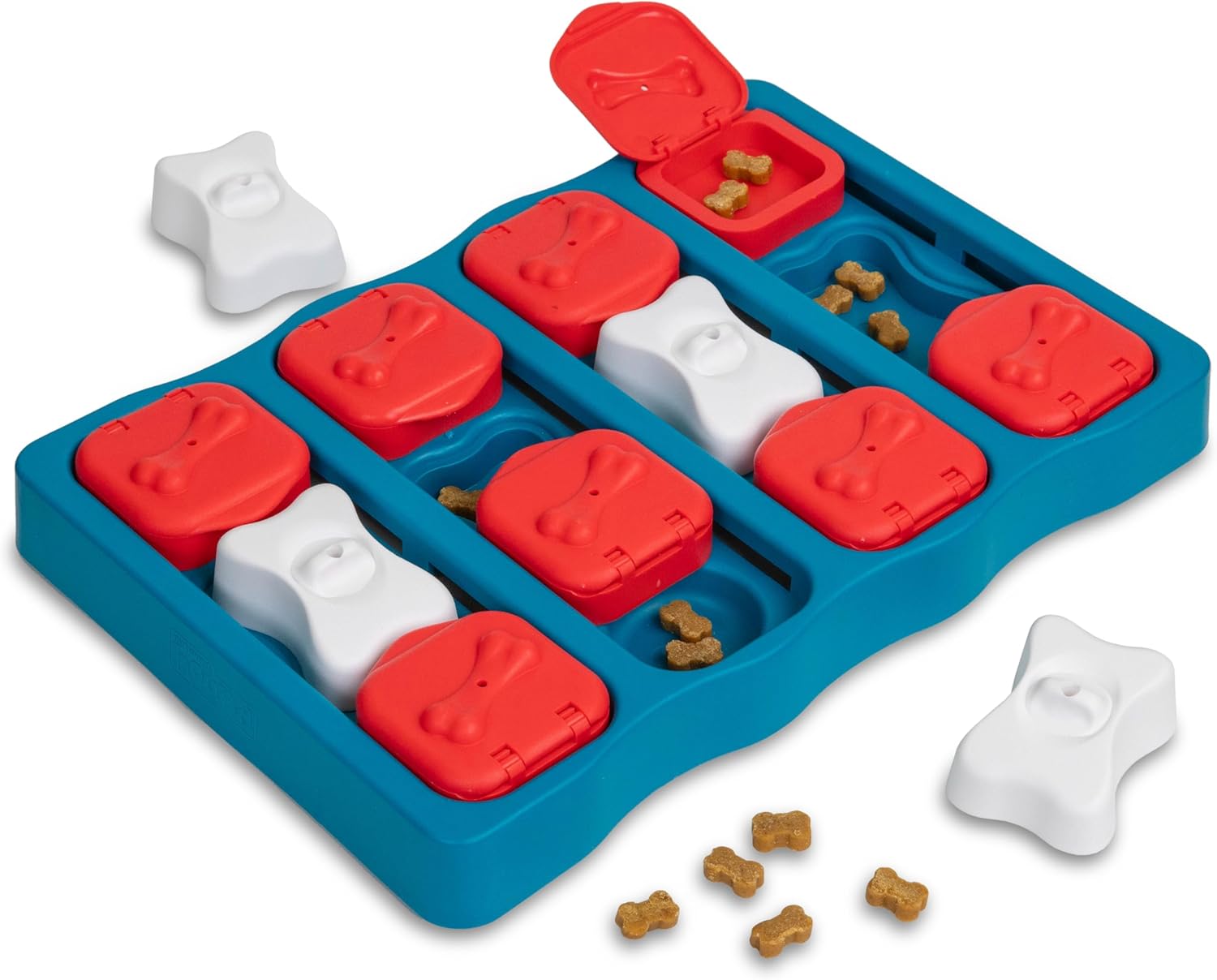
Read more: Best interactive dog toys
Weight Control Food by Dog Size
Weight control isn’t one-size-fits-all. The right formula depends on your dog’s size, age, and specific health considerations alongside weight management.
Small Breeds
Small dogs have high metabolic rates relative to their size and can be finicky eaters — a double challenge for weight control. A small dog who finds the low-calorie food bland may simply refuse to eat, which creates a different problem. Look for small breed weight control formulas that use higher-quality protein sources to maintain palatability while reducing calories. Kibble size also matters: small breeds need appropriately sized pieces. Royal Canin Weight Care makes size-specific weight control formulas for small and miniature breeds, which addresses both the calorie profile and kibble dimensions.
Medium Breeds
Most mainstream weight control formulas are calibrated for medium breeds, which makes this the easiest size to shop for. The macronutrient profiles described throughout this article apply most directly here. Purina Pro Plan Weight Management is a well-regarded option in this range, offering a high-protein, reduced-calorie formula that includes L-carnitine and has a solid track record of palatability — meaning dogs actually eat it willingly, which matters for long-term feeding compliance.
Large Breeds
Large breed weight control formulas serve double duty: they manage caloric intake and address joint health, which is critical for large dogs carrying any extra weight. Joint stress scales with weight in a nonlinear way — even a few extra pounds creates disproportionate load on hips, elbows, and knees in large dogs. Look for formulas that include glucosamine and chondroitin alongside the weight management profile. Hill’s Science Diet Perfect Weight is available in a large breed version that combines the calorie management profile with joint support nutrients, making it a sensible choice for large breed owners proactively managing weight.
Senior Dogs
Senior weight control formulas combine three goals: weight management, joint support, and reduced phosphorus (to support kidney health, which becomes more relevant in aging dogs). The caloric reduction in senior formulas is often paired with increased omega-3 fatty acids for cognitive and joint health. The tradeoff to watch is that senior formulas sometimes slightly reduce protein compared to younger adult formulas to ease kidney workload — monitor that protein remains above 24–25% DM in whatever senior weight control food you choose.
Vet Note: If your senior dog has confirmed kidney disease (CKD), weight management becomes a balancing act between caloric restriction and adequate protein intake. A board-certified veterinary nutritionist or a vet with an interest in clinical nutrition is the right resource here — this isn’t a situation where a standard senior weight control food is necessarily appropriate.
Transitioning to Weight Control Food and Monitoring Progress
Switching your dog’s food abruptly is a recipe for digestive upset — loose stools, gas, and a dog who refuses the new food after a bad experience with it. A 10-day transition prevents most of this.
10-Day Transition Protocol
| Days | Old Food / New Food Ratio |
|---|---|
| Days 1–2 | 75% old / 25% new |
| Days 3–4 | 50% old / 50% new |
| Days 5–6 | 25% old / 75% new |
| Days 7–10 | 100% new food |
Dogs with sensitive stomachs may benefit from extending the transition to 14 days, spending three days at each ratio rather than two. If you see loose stools at any stage, slow down the transition rather than pushing through.
Your Dog May Seem Hungry — This Is Normal
When a dog transitions from a higher-calorie food to a weight control formula, they often go through a one- to three-week adjustment period where they seem hungrier than usual. This is partly because the food volume may be slightly lower, and partly because their digestive system is adjusting to higher fiber content. The new food’s fiber will gradually produce a more sustained satiety response, but the body needs a few weeks to recalibrate. Resist the urge to add extra food during this window — if you can hold the correct portion through the first three weeks, most dogs settle into the new food without ongoing hunger signals.
Tracking Progress: What to Measure and When
Weight checks once a month are a reasonable starting rhythm. Weigh your dog at the same time of day (before a meal is most consistent) and record the number. A gradual, stable weight is success — even if you don’t see a decrease, holding weight steady on a dog who was previously gaining is a real win.
Body Condition Score reassessment every 6–8 weeks is more informative than scale weight alone, because it tells you whether what the dog carries is muscle or fat. Reassessing BCS at home is straightforward: can you feel (but not see) your dog’s ribs with gentle pressure? Is there a visible waist when you look at your dog from above? Does the belly tuck up slightly when viewed from the side? A BCS of 4–5 out of 9 means all three answers are yes. That’s where you want to stay.
Adjusting When Progress Stalls
If your dog’s weight continues to creep up despite being on weight control food for four to six weeks, reduce daily portions by 10% before switching to a different food. Small reductions compounded over time are more effective and less disruptive than repeatedly changing formulas. Keep a simple log: date, portion in grams, weight. It takes five minutes a month and removes the guesswork from knowing whether your adjustments are working.
When to Escalate to Your Vet
Contact your vet if:
- Your dog continues to gain weight despite correct portions of weight control food after two months
- Your dog is losing weight rapidly or showing reduced appetite
- You notice increased thirst or urination alongside weight gain (can indicate hypothyroidism or Cushing’s disease)
- Your dog’s BCS has reached 7/9 or above — this now warrants a weight loss strategy rather than maintenance
Unexplained weight gain despite appropriate diet has medical causes about 10–15% of the time. Hypothyroidism, Cushing’s disease, and insulin resistance are the most common culprits. A basic blood panel can rule most of these out quickly.
Frequently Asked Questions
Is weight control dog food the same as diet dog food?
Not exactly. “Diet” dog food is an informal term people use for any food intended to reduce a dog’s weight, and it’s often used interchangeably with weight loss food. Weight control food is more specifically about prevention and maintenance — keeping a dog at a healthy weight — rather than active weight loss in an obese dog. An obese dog (BCS 7–9/9) typically needs a more aggressive caloric restriction than standard weight control food provides. The line blurs because the same product is sometimes used for both purposes, but the ideal application for weight control food is the borderline or at-risk dog, not the dog who needs to lose a significant amount of weight.
How long should a dog stay on weight control food?
For most dogs, weight control food is a long-term choice rather than a temporary phase. If the factors that made your dog prone to weight gain — breed genetics, neuter status, reduced activity level — are permanent, the diet that manages those factors should be permanent too. The exception is if a dog was put on weight control food to maintain weight after active weight loss: once stable for six months at a healthy BCS, your vet may advise whether a standard adult food at carefully controlled portions can maintain that weight, or whether weight control food continues to make more sense.
Can I mix weight control food with regular food?
You can mix them, but it undermines the purpose unless you’re in the middle of a transition. If you mix 50% weight control food with 50% regular food long-term, you end up with a calorie profile close to regular food. If you want to use a higher-calorie food your dog prefers alongside a lower-calorie base, calculate the combined caloric value per cup of the mixture and adjust portions accordingly. It’s more work than just feeding a single food, and the margin for error is larger.
My dog is always hungry on weight control food — what do I do?
First, give it three to four weeks. Most dogs adjust to the higher fiber content and feel more satisfied over time. If persistent hunger is a problem, try splitting the daily ration into three smaller meals rather than two — the total calories stay the same, but the dog never goes as long between feedings. Adding a small amount of cooked green beans, plain canned pumpkin (not pie filling), or cucumber to meals adds volume without meaningful calories. Slow feeder bowls extend meal duration and significantly reduce the “still hungry immediately after eating” behavior. If your dog is genuinely restless, pacing, or losing weight on the current portion, consult your vet — you may be underfeeding.
At what age should I switch to weight control food?
There’s no universal age — it depends on risk factors. For spayed or neutered dogs, consider it six months to a year post-surgery if weight starts to creep up. For high-risk breeds like Labs, Beagles, and Pugs, many owners and vets move to weight control food in early adulthood (1–3 years) as a preventive measure. For senior dogs, 7–8 years is a common transition point as activity levels and metabolism change. The trigger should be observed BCS creeping toward 5–6/9 or the presence of strong risk factors — not age alone.
Is weight control food bad for dogs who don’t need it?
For most healthy adults, occasionally eating weight control food isn’t harmful, but feeding it long-term to a lean, active dog may cause them to lose more weight than is healthy. A dog with a BCS of 4/9 who is fed a weight control food at standard portions may drop to 3/9 over time, which is underweight. The higher fiber content can also cause loose stools in some dogs who don’t need that level of fiber. Weight control food is specifically formulated for dogs whose caloric needs are lower than average — using it on a dog with normal or high caloric needs is using the wrong tool.
Can puppies eat weight control dog food?
No. Puppies have dramatically higher caloric and nutrient needs than adult dogs. Weight control food with its reduced fat, lower caloric density, and higher fiber content is not appropriate for a growing puppy. Feeding weight control food to a puppy can result in inadequate caloric intake for development, suboptimal bone and muscle growth, and nutritional deficiencies. Puppies need food labeled for “puppies” or “all life stages.” If you have concerns about a puppy’s weight, discuss it directly with your vet — puppy weight management requires a different approach entirely.
How is weight control dog food different from weight loss dog food?
Weight control food is designed for maintenance: keeping a borderline dog at a healthy weight, or sustaining a healthy weight after successful weight loss. Weight loss food — sometimes called therapeutic weight management or obesity management food — delivers more aggressive caloric restriction (often 240–280 kcal/cup or lower) and is typically recommended for dogs who are actively overweight (BCS 7+ out of 9). Therapeutic weight loss foods are sometimes prescription-only and are meant for supervised use with vet monitoring. Weight control food is available over the counter and appropriate for long-term feeding without ongoing clinical supervision, assuming the dog’s weight is stable.
Conclusion
Getting ahead of weight gain is one of the most practical things you can do for your dog’s long-term health. Extra weight compresses lifespans, accelerates joint wear, and worsens outcomes for almost every other health condition a dog might develop. Weight control dog food gives you a concrete, actionable tool — not a vague instruction to “feed less” — with a formulation designed to keep your dog full and satisfied while keeping calories in check.
The best weight management dog food for your dog is the one they’ll actually eat consistently, that fits your budget, and that delivers a calorie count appropriate for their size and activity level. Use the label-reading framework from this article to cut through the marketing language on the front of the bag and evaluate what’s actually inside. Pair the food switch with accurate portioning — ideally on a kitchen scale — and monthly weight checks, and you have a system that works without making your dog miserable or your life complicated.
If your vet said “watch the weight,” this is how you watch it — proactively, with the right food and the right portions, before the problem becomes much harder to reverse.
Related Reading
Disclaimer: This article is for informational purposes only and is not a substitute for professional veterinary advice. Always consult your veterinarian before making significant changes to your dog’s diet, especially if your dog has existing health conditions, is overweight, or is showing signs of illness. Individual dogs have individual nutritional needs that a vet can assess in person.