A Great Dane sleeping on a bed meant for a Labrador is a bit like you spending the night on a twin mattress — technically possible, never actually restful. But size alone isn’t the whole story. Large dogs don’t just need more surface area. They need beds engineered for heavier body weight, deeper joint pressure, higher heat output, and the kind of nightly punishment that compresses a cheap foam insert into a useless pancake within three months.
The right large dog bed supports your dog’s joints, holds its shape over time, and fits how your specific dog actually sleeps. This guide covers everything you need to make that decision confidently — from bed types and sizing to materials, features, and setup.
Always check: Foam density, cover washability, and whether the size listed is the outer dimension or the sleeping surface
Quick Summary
- Minimum size rule: The bed should be long enough for your dog to fully stretch out — measure nose to tail base, then add 6–12 inches
- Best for joint issues: High-density memory foam (3 lb/ft³ or higher) — not fiber fill, not low-density foam
- Best for chewers: Ballistic nylon or canvas cover with replaceable insert
- Best for senior dogs: Low-entry orthopedic with non-slip base and waterproof liner
- Always check: Foam density, cover washability, and whether the size listed is the outer dimension or the sleeping surface
Why Large Dogs Have Different Bed Needs Than Small Dogs
A dog bed isn’t just a soft surface — it’s a load-bearing surface. And when that load is 80, 100, or 150 pounds of dog, the engineering requirements change substantially. Here’s why large dogs can’t simply use a bigger version of a small dog bed:
Joint Pressure at Higher Body Weight
Large and giant breeds carry significantly more weight through their hips, elbows, and shoulders than small breeds do. When a heavy dog lies on an inadequately supportive surface, the bony prominences — hips, elbows, sternum — press through the cushioning and contact the hard floor beneath. This is called “bottoming out,” and it defeats the entire purpose of the bed. For dogs who already have early arthritis or hip dysplasia, sleeping on an inadequate surface actively worsens joint inflammation overnight.
A quality large dog bed needs to distribute weight evenly across the full sleeping surface — spreading pressure rather than concentrating it at contact points. This requires foam density and depth that cheap beds simply don’t provide.
Orthopedic Concerns Are the Rule, Not the Exception
Hip dysplasia, elbow dysplasia, and degenerative joint disease are dramatically more prevalent in large and giant breeds than in small ones. German Shepherds, Labrador Retrievers, Golden Retrievers, Rottweilers, and Great Danes all have high rates of joint conditions by middle age. A supportive bed doesn’t prevent these conditions — but it meaningfully reduces the discomfort of living with them, particularly during the long hours your dog spends lying down each day. For a dog with joint disease, bed quality is a welfare issue, not a luxury.
Heat Retention
Large dogs generate more body heat than small dogs and dissipate it less efficiently relative to their mass. Many large breeds run hot, sleep hot, and will actively avoid overly soft, insulating beds in warm conditions. Beds with cooling properties — elevated designs, gel-infused foam, breathable covers — are often preferred by large dogs in a way that small breeds rarely show a preference for.
Durability Demands
A 10-pound dog jumping onto a bed and a 100-pound dog dropping onto one are not comparable events. The sheer weight cycling — landing, shifting, getting up, lying back down, several times a night — compresses foam and flattens fiber fill far faster in large breed beds. A bed that would last three years under a small dog might last three months under a Saint Bernard. Construction quality, foam density, and cover durability matter exponentially more when the user weighs over 60 pounds.
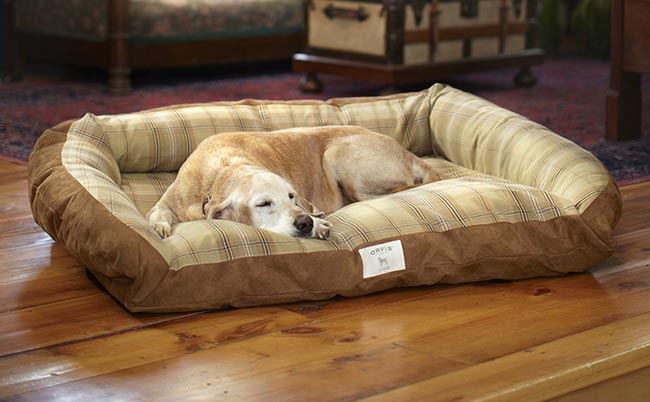
Types of Large Dog Beds
Not every large dog needs the same solution. The six main bed types each serve a different set of needs — here’s what each one actually offers and which dogs benefit most.
1. Orthopedic / Memory Foam Beds
The gold standard for large dogs with joint issues. Orthopedic dog beds use high-density memory foam or a combination of memory foam and support foam to conform to the dog’s body, distribute weight evenly, and cushion pressure points. The critical specification is foam density — anything under 3 lb/ft³ will compress under a large dog’s weight within months. Quality orthopedic beds use 4–5 lb/ft³ memory foam in a layer of 3–4 inches, sometimes over a firmer support base.
Best for: Dogs with arthritis, hip dysplasia, elbow dysplasia, post-surgical recovery, or any dog over 7 years old.
Limitation: Retains heat; heavier dogs who sleep hot may prefer a cooler alternative. More expensive.
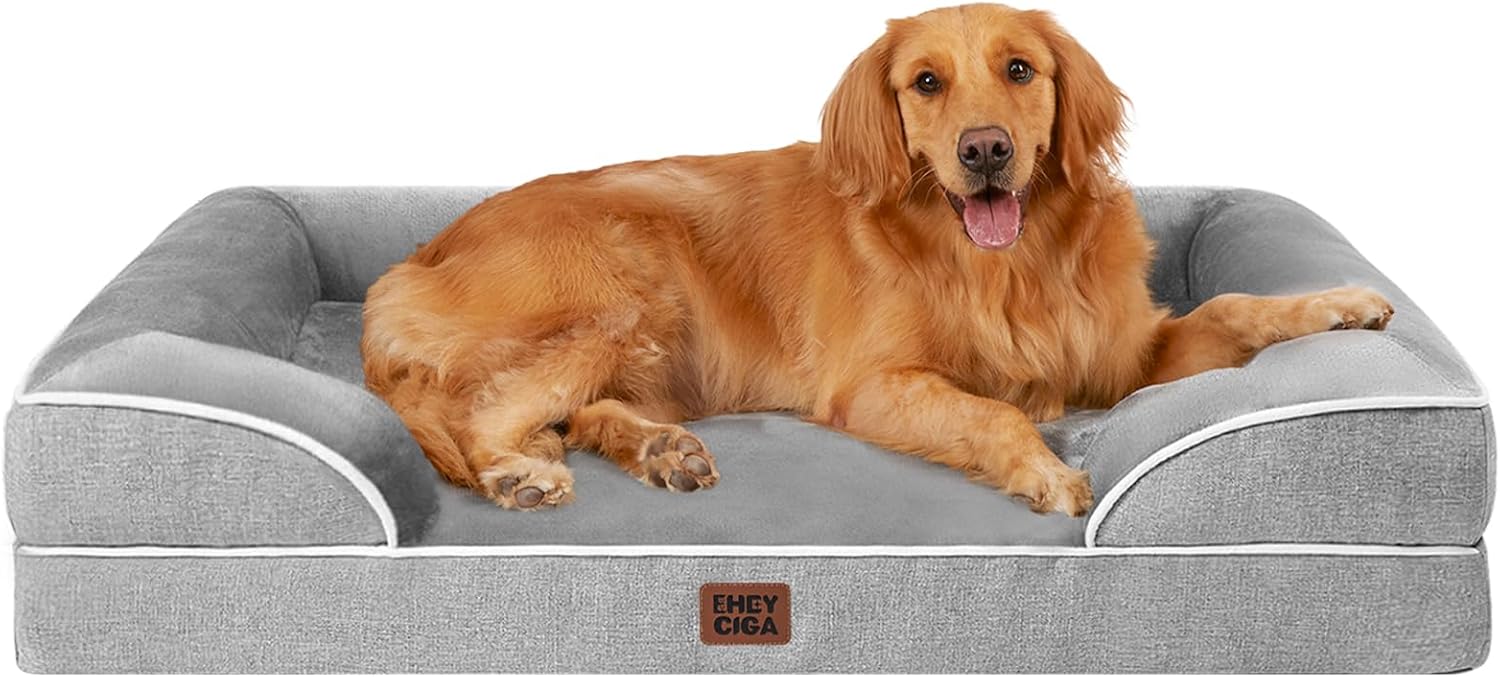
Our suggestion: EHEYCIGA Orthopedic Dog Beds for Extra Large Dogs
2. Raised / Elevated (Cot-Style) Beds
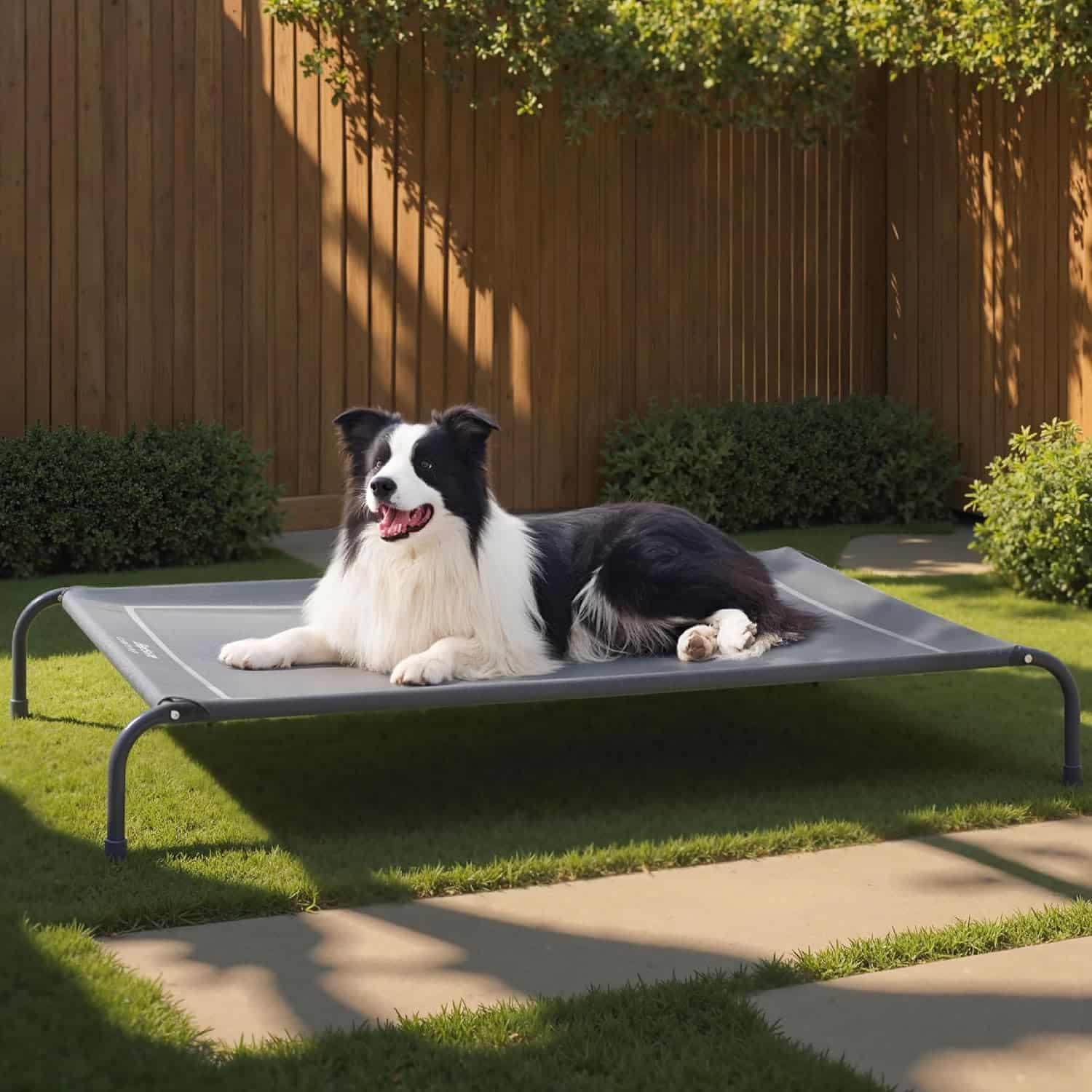
Elevated beds suspend the dog above the floor on a stretched fabric surface, similar to a camping cot. The elevated position keeps the dog off cold or hot floor surfaces, allows airflow underneath the body, and keeps the dog cool. They’re extremely durable — there’s no foam to compress — and most are easy to clean. Many large dogs who refuse to use soft beds will readily use an elevated cot.
Best for: Dogs who sleep hot, outdoor/indoor dogs, dogs who chew or destroy foam beds, multi-surface households (easy to move between rooms or outdoors).
Limitation: No cushioning for dogs with significant joint pain. Dogs with mobility issues may struggle with the step up.
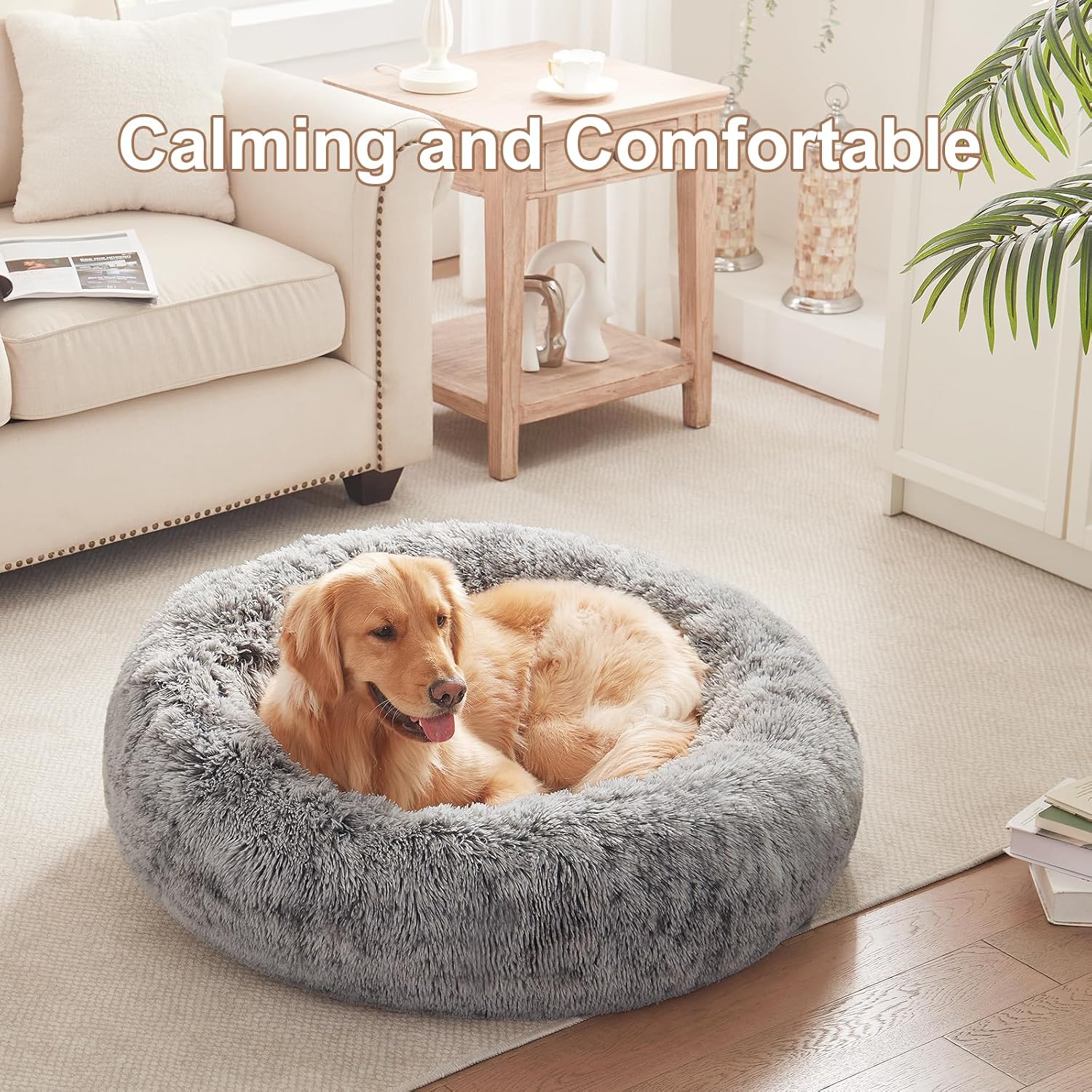
3. Bolster / Donut Beds
These have raised sides or a surrounding bolster that the dog can rest their head or back against. Many dogs — particularly anxious breeds or dogs who naturally curl up — strongly prefer the security of something to lean against. For large dogs, the bolster needs to be substantial enough to actually support the dog’s head and neck rather than just being decorative.
Best for: Dogs who curl up to sleep, anxious or insecure dogs, dogs who press against furniture or walls when resting.
Limitation: The enclosed design retains more heat. Some large dogs prefer to fully stretch out and find the bolster restrictive.
Try Bedstill Store
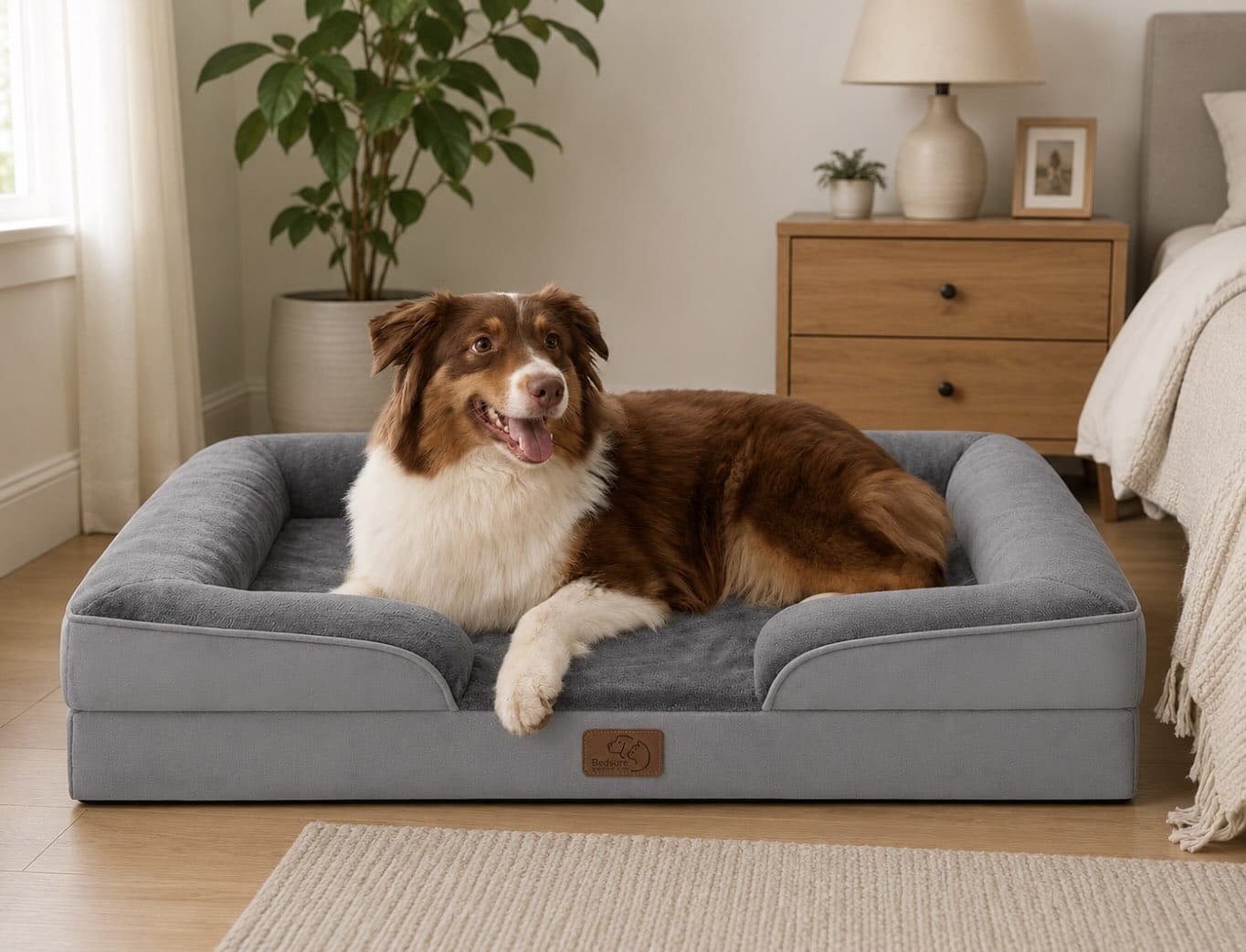
4. Waterproof / Washable Beds
Not a shape category — more of a construction feature that deserves its own consideration for large dogs. Waterproof beds have a liner between the cover and the foam that prevents moisture (urine, drool, wet paws) from reaching the foam core. Once foam absorbs moisture, it degrades rapidly and becomes a bacterial environment that can’t be laundered out. For incontinent dogs, senior dogs, dogs with skin conditions, or simply dogs who drool heavily — waterproof construction is not optional.
Best for: Senior dogs with incontinence, dogs recovering from surgery, any large breed that drools significantly (Mastiffs, Saint Bernards, Bloodhounds).
Limitation: Waterproof liners can crinkle or reduce breathability if poorly constructed. Quality varies widely.
Try BedSure Store
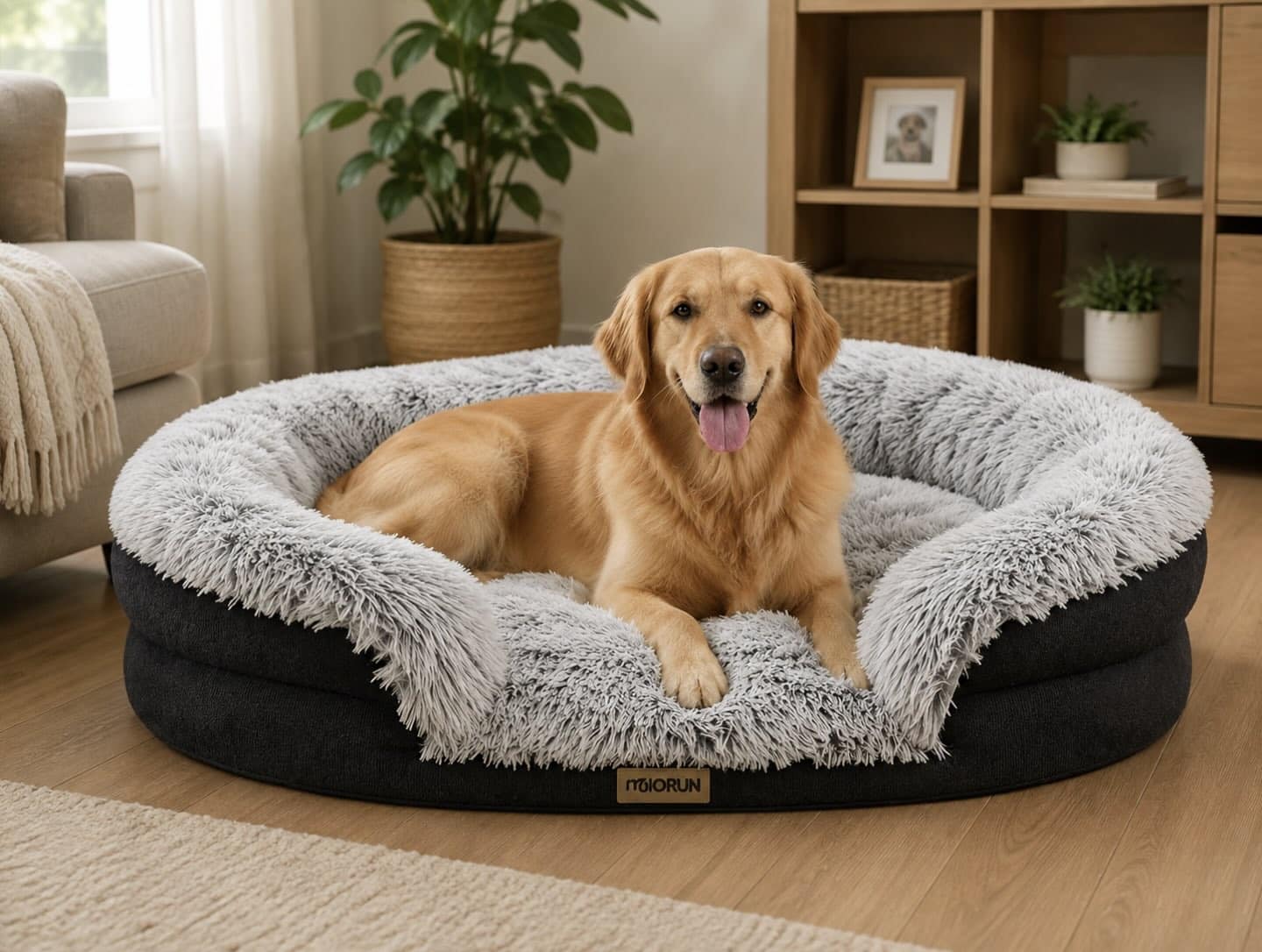
5. Giant Floor Mat / Sofa-Style Beds
Large flat mats or “sofa beds” that provide a broad, low sleeping surface without defined edges. These suit dogs who don’t want a defined sleeping “zone” — they sprawl, spread, and change position freely throughout the night. For multi-dog households or dogs who share sleep space with their owners, a large flat mat is often more practical than a defined bed shape.
Best for: Sprawling sleepers, multi-dog households, dogs who move around a lot overnight.
Limitation: No head or body support from raised edges. Can slide on hard floors without a non-slip base.
Try Miorun’s Bed
6. Cooling Beds
Designed specifically to draw heat away from the dog’s body. Two main types: gel-infused memory foam (absorbs heat passively) and pressure-activated cooling gel pads (activate on contact, no electricity required). For large breeds in warm climates or breeds that genuinely overheat — Bulldogs, Boxers, Chow Chows — a cooling bed can meaningfully improve sleep quality and reduce heat-related restlessness.
Best for: Large dogs in warm climates, brachycephalic breeds, dogs who pant at rest during warm weather.
Limitation: Gel pads are not supportive — not appropriate as a sole sleeping surface for dogs with joint issues. Use over an orthopedic base if joint support is also needed.
How to Get the Right Size
This is where most people make their first mistake — buying by breed name (“Labrador size”) rather than by actual measurement. Breed standards have wide weight ranges, and individual dogs vary significantly. The only reliable method is measuring your specific dog.
How to Measure Your Dog
- Length: Measure from the tip of the nose to the base of the tail (not tip of the tail) while the dog is standing. Add 6–12 inches to this measurement — this is your minimum bed length.
- Width: Measure your dog’s shoulder width, then multiply by 2. This accounts for a dog that sleeps on their side with legs extended.
- Measure how they actually sleep. A dog who always curls tight can use a smaller bed than a dog who sprawls fully extended every night. Watch your dog sleeping for a few nights before you buy.
Large Dog Beds Size Reference
| Bed Size Label | Typical Dimensions | Suitable For (examples) |
|---|---|---|
| Large | 36″ × 27″ (approx.) | Border Collie, Cocker Spaniel (large end), Beagle (large) |
| X-Large | 42″ × 30″ (approx.) | Labrador Retriever, Golden Retriever, Boxer, Siberian Husky |
| XX-Large | 52″ × 34″ (approx.) | German Shepherd, Rottweiler, Bernese Mountain Dog, Doberman |
| XXX-Large / Giant | 60″ × 40″ or larger | Great Dane, Saint Bernard, Mastiff, Newfoundland, Irish Wolfhound |
Important note: When comparing beds from different brands, always check whether the size listed is the outer dimension of the bed or the usable sleeping surface. A bolster bed listed as 48 inches may have a 40-inch sleeping surface inside the bolster walls. For accurate comparison, ask for interior dimensions.
Should Your Dog Be Able to Fully Stretch Out?
Ideally, yes — but it depends on how your dog sleeps. A dog who always curls into a tight circle doesn’t need a bed they can fully extend on. A dog who sleeps sprawled on their side with all four legs extended does. The safest approach: if you’re unsure, size up. A dog on a bed slightly too large suffers no consequence. A dog on a bed slightly too small misses the support they need.
What Materials Actually Matter for Large Dogs
The materials inside and outside large dog beds determine how long it lasts, how well it supports your dog, and how easy it is to maintain. These are the specifications worth understanding before you buy.
1. Foam Density — The Most Important Spec Nobody Mentions
Foam density is measured in pounds per cubic foot (lb/ft³) and tells you how much material is packed into the foam — which directly determines how long it supports weight before compressing permanently.
| Foam Density | Performance Under Large Dogs | Verdict |
|---|---|---|
| Under 1.5 lb/ft³ | Bottoms out within weeks under dogs over 50 lbs | Avoid for large breeds |
| 1.5–2.5 lb/ft³ | Adequate for dogs under 50 lbs; too soft for larger dogs long-term | Medium breeds only |
| 3–4 lb/ft³ | Good support for dogs 50–100 lbs; holds shape for 1–2 years with normal use | Good for most large breeds |
| 4–5 lb/ft³ | Excellent support for dogs 80–150+ lbs; durable long-term | Best for giant breeds and dogs with joint disease |
Most budget dog bed brands don’t publish foam density figures. If a brand won’t tell you the density of their foam, assume it’s on the low end. Reputable orthopedic dog bed brands list this specification clearly because it’s their selling point.
2. Cover Fabric
The cover takes the daily abuse — claws, saliva, mud, rolling, and scratching. For large dogs:
- Ballistic nylon: The most durable option. Tear-resistant and water-resistant. Recommended for dogs who scratch or dig at their beds before lying down. Less soft to the touch than fabric options.
- Canvas or oxford weave: Durable and breathable. A good middle ground between durability and comfort. Holds up well under large dogs without the stiffness of ballistic nylon.
- Plush or sherpa: Soft and comfortable but poor durability under large dogs. Attracts hair, pills quickly, and is easily damaged by claws. Best used on small or calm dogs who don’t scratch.
- Waterproof outer: Some covers are fully waterproof — practical but often less comfortable. Better as a second-layer liner than as the primary cover your dog sleeps against.
Look for covers that are fully removable and machine washable. A cover that can’t be washed is a hygiene liability within weeks of regular large dog use.
3. Fill Material
- Solid memory foam slab: Best support, most durable shape retention, highest cost. The right choice for dogs with joint issues or dogs over 80 lbs.
- Shredded foam: More affordable than solid foam and initially comfortable, but migrates, clumps, and flattens unevenly over time. Less consistent support. Fine for younger dogs without joint issues.
- Polyester fiber fill: The least supportive option. Compresses quickly under large dogs and doesn’t return to shape. Acceptable as bolster fill around a foam base, but not as a primary sleeping surface for dogs over 50 lbs.
- Combination (memory foam + support base): Many quality large dog beds use a firmer base foam with a memory foam comfort layer on top. This prevents bottoming out while still providing pressure-point cushioning — often the best of both worlds.
4. Waterproof Liner
Even if your dog isn’t incontinent, a waterproof liner between the cover and the foam is worth having. Foam that absorbs water — from post-bath dampness, outdoor adventures, drool — degrades faster and becomes harder to clean effectively. A removable waterproof liner adds years to the foam core’s lifespan and keeps the interior hygienic. This is non-negotiable for senior dogs, post-surgical dogs, or any breed prone to heavy drooling.
Features to Prioritize by Your Dog’s Situation
Once you know the type and size you need, these are the specific features worth prioritizing based on your dog’s individual circumstances — not every dog needs every feature.
Dog with Joint Issues (Arthritis, Hip Dysplasia)
- High-density memory foam: 4 lb/ft³ minimum, 4-inch depth minimum
- Low entry height: the dog shouldn’t have to step up significantly to get on and off — this strains already-compromised joints
- Non-slip base: dogs with arthritis have reduced stability and need the bed to stay in place when they get on and off
- Firm enough not to bottom out: a bed that sinks to the floor defeats the orthopedic purpose entirely
Heavy Chewer or Destructive Dog
- Ballistic nylon or ripstop canvas outer cover
- Replaceable insert: a bed where you can swap the foam without replacing the whole thing is far more economical
- Consider an elevated cot: no foam to destroy — the stretched fabric surface is far more chew-resistant than any foam bed
- Avoid beds with exposed stitching edges, zippers, or decorative trim — these are the first things destructive dogs target
Senior Dog (7+ Years)
- Waterproof liner: incontinence becomes more common as dogs age
- Very low step-in height: ideally flush with or barely above the floor
- Soft but supportive: aging dogs often lose muscle mass (sarcopenia), which reduces their natural cushioning — the bed needs to compensate
- Non-slip cover or rubber base: senior dogs often have reduced rear-end strength and need stability when getting up
- Easy to clean: more frequent washing is typical with older dogs
Dog Who Splits Time Indoors and Outdoors
- Elevated cot-style bed for outdoors (drains water, doesn’t absorb mud)
- A separate indoor orthopedic bed rather than moving one bed back and forth
- For the outdoor bed: UV-resistant fabric, rust-proof frame, fabric rated for outdoor use
- Consider a cover with a hose-down-clean design for the outdoor option
Multi-Dog Household
- Size for the largest dog — smaller dogs will use it too; the reverse doesn’t work
- Flat mat or sofa-style bed: more flexible than a defined bed shape when multiple dogs share space
- Enough beds for each dog to have their own: resource guarding over sleeping spots is a common trigger for inter-dog conflict
- Easy washability: more dogs = faster soil accumulation
Floor Level vs. Elevated for Dogs with Mobility Issues
Counter-intuitively, dogs with arthritis often benefit from a bed that’s slightly raised off the floor (4–6 inches) rather than completely flat. Getting up from a fully flat position on the ground requires more joint effort than rising from a low platform. A bed with some height — enough to give leverage, not so high as to require a jump — can make a real difference in how easily your dog gets on and off multiple times a night.
Washing and Maintenance
Large dog beds need washing more frequently than most owners realize — at minimum every 2 weeks for the cover, and once a month for the liner if present. Between washes, weekly vacuuming removes hair and dander that builds up in the fabric. For beds with foam cores: spot-clean with a damp cloth and mild soap, then air dry completely before replacing the cover. Never put foam in the washing machine or dryer — it destroys the structure. Sun-drying the foam core outdoors for a few hours each month freshens it and reduces bacteria naturally.
Frequently Asked Questions
How big should a dog bed be for a 100 lb dog?
For a 100 lb dog, you’re looking at a minimum of 48″ × 36″ for a dog who curls up, and 54″ × 40″ or larger for a dog who sleeps stretched out. Measure your dog nose to tail base, add 10 inches for length, and double the shoulder width for the width dimension. When in doubt, size up — there’s no downside to a bed that’s slightly too large.
Can large dogs use memory foam beds designed for humans?
Human memory foam mattresses can work well if the density is adequate (3–5 lb/ft³ for large dogs) and you add a removable, washable cover. The main drawbacks are size (often larger than necessary, harder to wash), and the fact that they lack the practical features of purpose-built dog beds — waterproof liners, non-slip bases, washable covers designed for pet hair.
How often should I replace a large dog bed?
A quality orthopedic large dog bed should last 3–5 years with normal use. Signs it’s time to replace: the foam bottoms out (you can feel the floor when you press down), the dog starts avoiding the bed, the foam no longer returns to shape after the dog gets up, or persistent odor that washing doesn’t eliminate.
My dog keeps jumping off the bed and sleeping on the floor — what’s wrong?
Three common reasons: the bed retains too much heat, the bed is too soft and the dog feels unstable, or the bed placement is wrong (too exposed, near a vent, or away from where the family is). Try repositioning first, then assess whether a firmer or cooler surface might suit your dog better. Some large dogs genuinely prefer a firm, cool floor and will accept a bed only as a supplementary option.
What’s the best large dog bed for dogs with hip dysplasia?
Look for: solid memory foam at 4+ lb/ft³ density, minimum 4-inch foam depth, very low step-in height, non-slip base, and a removable washable cover. Orthopedic dog beds marketed specifically for dogs with joint disease — from brands like Big Barker, FurHaven, or Bully Beds — tend to meet these specifications and publish their foam density clearly. Avoid any bed where you can press through to feel the floor — that bed provides no meaningful joint relief regardless of how it’s marketed.
Are raised dog beds good for large breeds?
Yes — with important caveats. Elevated cot beds are excellent for cooling, durability, and dogs who don’t have significant joint pain. But they’re not appropriate as the primary sleeping surface for dogs with moderate to severe arthritis or hip dysplasia, because the firm fabric provides no cushioning for pressure points. For dogs with joint issues, a high-density orthopedic bed is the priority. For healthy large dogs who sleep hot or destroy foam beds, a raised cot is one of the best options available.
How do I stop my large dog from destroying their bed?
For diggers: a bolster bed with defined edges often reduces the behavior, as does providing more physical and mental stimulation during the day. For chewers: switch to a ballistic nylon cover (much harder to damage), a raised cot bed (no foam to access), or a flat canvas mat with no protruding edges. For both: ensure your dog is getting adequate exercise. A well-exercised large dog lies down and sleeps — they don’t redecorate their bed.
The Bottom Line
At the end of the day, choosing a large dog bed comes down to three questions we ask ourselves every time: Does it actually fit your dog’s measurements, not just their “size category”? Does the foam density hold up under their real weight, night after night? And does it suit how your specific dog sleeps and lives — not some idealized dog on the packaging?
We’ll say this plainly: the most expensive bed isn’t automatically the best one. A simple elevated cot might be exactly right for an energetic, hot-sleeping Labrador who just wants airflow and a spot off the cold floor. A high-density orthopedic bed is the right call for an older Rottweiler managing hip dysplasia, where every bit of support matters. We’ve bought the wrong bed before — the pretty one, the one with good reviews for “large dogs” in general — and watched our own dog just… not use it. Getting this right means actually knowing your dog: how they sleep, what their body is dealing with, what they’ve destroyed in the past — and matching the bed to that reality instead of to whatever the box promises.
Here’s the takeaway: buy once, buy right. A quality bed that actually fits and holds its shape will serve your dog for years without a second thought. A cheap one that flattens out in a few months ends up costing more anyway — in replacements, sure, but also in the comfort your dog just didn’t get for those months you didn’t realize it had already gone flat.
Related Reading from The Pet Geek
This article contains general information for dog owners. For dogs with diagnosed orthopedic conditions, consult your veterinarian for specific recommendations suited to your dog’s condition and mobility level.