Best Puppy Chow Dog Food: Top Picks for Every Budget

Choosing the right puppy chow dog food is one of the most important decisions you’ll make in your dog’s first year. Puppy food isn’t just smaller kibble — it’s a nutritionally distinct formula engineered for rapid growth, brain development, and immune system building. The right formula at this stage genuinely matters.

The problem: the pet food aisle is overwhelming. Every bag promises to be the best. Marketing language — “natural,” “premium,” “wholesome” — is everywhere and means almost nothing without looking at what’s actually inside. This guide cuts through that noise with honest reviews of the best puppy chow dog food options across every price tier, so you can match the right formula to your puppy’s actual needs and your actual budget.

Quick Summary: Our Top Picks

  • Best overall: Purina Pro Plan Puppy — best combination of nutrition science and real-world results
  • Best for large breeds: Royal Canin Large Puppy — most precise large breed growth management
  • Best vet-recommended: Hill’s Science Diet Puppy — widely endorsed, consistently formulated
  • Best natural formula: Blue Buffalo Life Protection Puppy — no by-products, LifeSource Bits antioxidant blend
  • Best grain-free: Taste of the Wild High Prairie Puppy — novel proteins, strong palatability
  • Best mid-range: Purina ONE Smart Blend Puppy — close to Pro Plan quality at a lower price
  • Best budget pick: Iams ProActive Health Smart Puppy — most nutritious formula at lowest price tier

What Makes a Puppy Food Worth Buying

Before the reviews, a quick breakdown of what actually separates a quality puppy food from a mediocre one. These are the criteria used to evaluate every product in this list.

  • AAFCO nutritional adequacy statement for growth: Non-negotiable. The label must state “formulated to meet the nutritional levels established by the AAFCO Dog Food Nutrient Profiles for growth” or “all life stages.” No statement = unverified nutrition.
  • Named protein as the first ingredient: Chicken, beef, salmon, lamb — a specific animal species listed first. “Meat meal” or “poultry” without a named species is a step down in quality.
  • DHA source: Docosahexaenoic acid supports brain and eye development in puppies. Quality puppy foods include it from fish oil or naturally DHA-rich ingredients.
  • Appropriate calcium levels: Critical for large breed puppies specifically — too much calcium during rapid growth contributes to developmental bone problems. Large breed formulas manage this; standard puppy formulas do not.
  • Protein percentage: AAFCO minimum is 22% crude protein for puppies. Quality formulas generally provide 26–36%. More isn’t always better — large breed puppies need controlled growth, not maximum caloric density.
  • Transparency: Brands that publish feeding trials, AAFCO protocols, and nutritional research earn more trust than those who rely purely on marketing language.

Best Puppy Chow Dog Food: Full Reviews

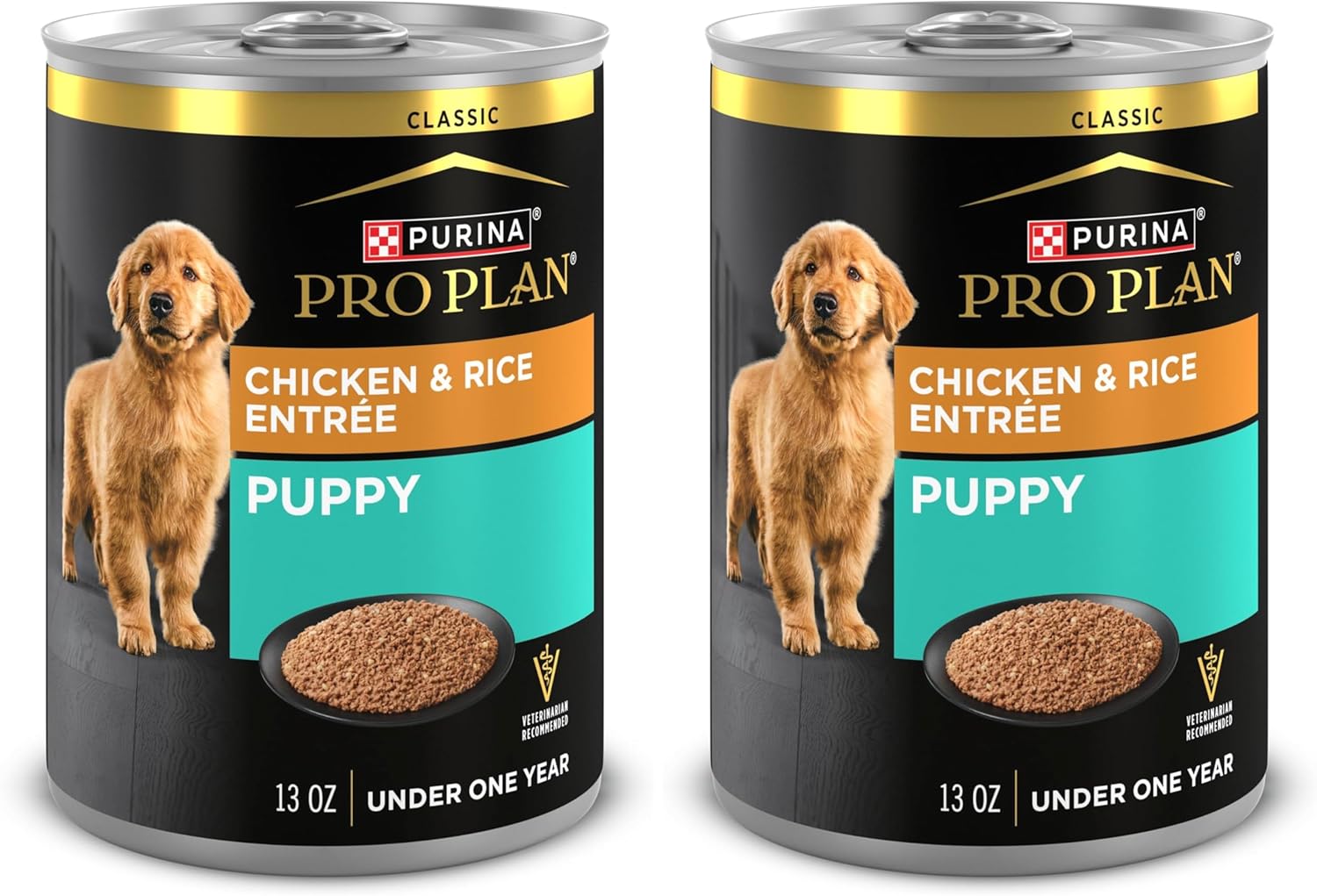
#1 — Purina Pro Plan Puppy (Best Overall)

If there’s one puppy food that veterinary nutritionists, breeders, and veterinarians recommend more than any other, it’s Purina Pro Plan. That’s not marketing — it’s the result of decades of investment in nutritional research, feeding trials, and post-market health monitoring. Pro Plan formulas are developed with veterinary scientists and tested on live animals through AAFCO feeding protocols, not just formulated to meet nutrient targets on paper.

The flagship Chicken & Rice formula lists chicken as the first ingredient, includes DHA from omega-3-rich fish oil, and delivers 30% crude protein — well above the minimum needed for healthy puppy growth. The kibble size is appropriate for medium to large breed puppy mouths, and palatability is consistently high.

What stands out:

  • Backed by more peer-reviewed nutritional research than virtually any other consumer puppy food brand
  • Chicken is the first ingredient, followed by chicken meal — a double dose of quality named protein before any grain sources
  • Live probiotics (Lactobacillus) for digestive and immune health — and unlike many probiotic claims in pet food, Purina has published data on survival rates through manufacturing
  • Multiple formulas within the line: Small & Toy, Large Breed, Sensitive Skin & Stomach, High Protein, and breed-specific options
  • Consistent formulation — Pro Plan doesn’t reformulate frequently, so once your puppy adjusts, the food stays the same

What to know:

  • Contains corn and wheat in many formulas — not appropriate for grain-sensitive puppies
  • Price sits in the mid-premium range — noticeably more expensive than budget options but competitive with other science-backed brands
  • Some formulas use “poultry by-product meal” as a secondary protein — transparent, nutritious, but lower-tier than named meal

Best for: Most healthy puppies, small to large breeds. The Large Breed formula for puppies expected to exceed 50 lbs at adult weight. The go-to recommendation when you want feeding-trial-backed nutrition without ultra-premium pricing.

purina puppy chow dog food

#2 — Royal Canin Puppy (Best for Large Breeds and Specific Needs)

Royal Canin’s approach to puppy nutrition is unlike any other brand: they engineer formulas specifically for breed size, and in many cases, for specific breeds. Their giant breed, large breed, medium breed, and small breed puppy formulas are nutritionally distinct — not just repackaged versions of the same food with different kibble sizes. This precision matters most for large and giant breed puppies, where calcium levels, caloric density, and growth rate genuinely need to be controlled.

The Large Puppy formula, for puppies expected to reach 55–100 lbs at adult weight, is designed to support a steady, controlled growth rate — not rapid weight gain. The Giant Puppy formula extends this for dogs expected to exceed 100 lbs. The kibble shape is uniquely designed for each size category to encourage chewing rather than gulping, which improves digestion and slows eating in large dogs prone to bloat.

What stands out:

  • Most precise breed-size calibration on the market — the large and giant formulas genuinely do things other brands don’t
  • Breed-specific lines available for puppies like German Shepherds, Labrador Retrievers, Golden Retrievers, and French Bulldogs — with kibble shapes and nutrient profiles engineered for that breed’s anatomy and predispositions
  • Excellent digestibility — high-quality protein and fiber blend results in consistent, small, firm stools (a practical metric of how well the food is absorbed)
  • Widely used by professional breeders, particularly in large breed circles

What to know:

  • Ingredient list is not “clean” by modern standards — corn, wheat, chicken by-product meal, and artificial preservatives appear in most formulas. Royal Canin’s philosophy prioritizes nutritional precision over ingredient marketing.
  • One of the more expensive puppy foods on the market — especially the breed-specific lines
  • Some dogs find it less palatable than chicken-forward formulas — the ingredient profile is engineered for nutrition, not aroma

Best for: Large and giant breed puppies (German Shepherds, Golden Retrievers, Great Danes, Saint Bernards, Mastiffs). Breed-specific formulas for owners who want the most targeted nutritional approach available commercially.—

#3 — Hill’s Science Diet Puppy (Best Vet-Recommended)

Hill’s Science Diet is the brand most commonly found in veterinary clinic waiting rooms, and that’s not a coincidence. Hill’s has invested heavily in veterinary education and in conducting and publishing nutritional research, making it the brand most frequently recommended by general practice veterinarians. The Puppy formula uses chicken meal as the primary protein source, whole grain oats, and barley — a cleaner grain profile than corn-based alternatives.

One thing worth knowing: Hill’s Science Diet Puppy is not the same as Hill’s Prescription Diet. The Prescription line requires a veterinary prescription and is used therapeutically. The Science Diet line is available over the counter and is designed for healthy dogs. Both are made by the same company but serve entirely different purposes.

What stands out:

  • Chicken meal (a concentrated named protein source) leads the ingredient list — high protein density from quality named meat
  • Whole grain oats and barley instead of corn — a grain profile many owners prefer
  • Clinically proven antioxidants to support a healthy immune system during the puppy growth period
  • Small & Toy and Large Breed versions available — the Large Breed formula appropriately controls calcium for growth management
  • Consistent, predictable formulation — important for puppies who do poorly with dietary changes

What to know:

  • Chicken meal, not whole chicken, is the first ingredient — this is nutritionally fine (meal is more protein-dense than whole meat) but some owners prefer seeing whole meat first
  • Price is mid-premium — comparable to Pro Plan
  • Less research published on probiotics or microbiome health compared to Pro Plan’s more recent formulation work

Best for: Healthy puppies whose owners prefer vet-endorsed brands; puppies who do well on grain-inclusive formulas with oats and barley; households that value consistency and clinical backing over premium ingredient marketing.—

#4 — Blue Buffalo Life Protection Puppy (Best Natural Formula)

Blue Buffalo built its brand on the “no chicken by-products, no corn, no wheat, no soy, no artificial preservatives” platform — and the Life Protection Puppy formula delivers on that. Deboned chicken is the first ingredient, followed by chicken meal, then whole grains (brown rice, barley, oats). The signature feature is the LifeSource Bits: small dark kibble pieces with a cold-formed antioxidant and nutrient blend that the company claims is processed at lower temperatures to preserve potency.

Blue Buffalo occupies an interesting position: it’s more expensive than traditional mid-range foods but less expensive than ultra-premium brands, with ingredient lists that appeal to owners who read labels carefully. The brand did face a class action lawsuit in 2016 related to by-product meal found in some formulas despite “no by-products” claims, and Purina filed a lawsuit over the same issue. Blue Buffalo settled. Their formulations have since been more closely scrutinized and the issue appears resolved — but it’s worth knowing the history.

blue buffalo puppy dog food

What stands out:

  • Deboned chicken first, chicken meal second — strong named protein foundation
  • No corn, wheat, soy, or artificial preservatives — genuinely cleaner ingredient list than most competitors at this price
  • LifeSource Bits provide a cold-formed vitamin and antioxidant supplement within the kibble itself
  • Very broad product range: puppy formulas for small breeds, large breeds, and a grain-free option
  • DHA from fish oil for brain and eye development

What to know:

  • Pea protein and pea fiber appear in some formulas — adding plant-based protein that inflates crude protein percentages without the amino acid quality of meat protein
  • Some Blue Buffalo formulas have been associated with digestive upset in puppies with sensitive stomachs — the richness of the formula can be a factor
  • The grain-free Blue Buffalo Wilderness line uses legumes as carbohydrate sources — relevant given the FDA’s ongoing DCM investigation into high-legume grain-free diets

Best for: Owners who prioritize clean ingredient lists and named-protein transparency; puppies without grain sensitivity who can digest the richer formula; households where “natural” labeling and by-product-free sourcing is a purchase driver.—

#5 — Taste of the Wild High Prairie Puppy (Best Grain-Free)

Taste of the Wild is the go-to brand in the grain-free puppy food category — genuinely novel protein sources (roasted bison, roasted venison), affordable pricing for grain-free, and a palatability level that stands out even among picky puppies. The High Prairie Puppy formula delivers 28% crude protein from buffalo and lamb meal alongside sweet potatoes and peas as the carbohydrate base.

The grain-free context requires an honest note: the FDA has been investigating a potential link between grain-free, high-legume diets and dilated cardiomyopathy (DCM) in dogs since 2018. The investigation is ongoing and no definitive causal link has been established. Taste of the Wild specifically commissioned independent research in response and found no cardiac abnormalities in dogs fed their formulas. The risk, if it exists, appears to be most relevant for breeds already predisposed to DCM. This is context worth having, not a reason to panic — but it’s information that should inform the decision for any grain-free food.

What stands out:

  • Buffalo is the first ingredient — a genuinely novel protein that most puppies haven’t encountered before, making it suitable for early food variety exposure
  • Strong palatability — most puppies take to this formula enthusiastically
  • Added probiotics (Lactobacillus species) for gut health support
  • Competitive price for grain-free — significantly less expensive than premium grain-free alternatives
  • Made in the USA

What to know:

  • Contains peas, lentils, and legumes as primary carbohydrate sources — relevant given the FDA DCM investigation context above
  • Not appropriate for large breed puppies as the primary formula — the caloric density and calcium levels are not large-breed calibrated
  • Some puppies experience initial loose stools when transitioning to this formula — the novel proteins and higher fat require a slower transition period

Best for: Small to medium breed puppies in households that want grain-free; puppies being introduced to novel proteins early; owners whose previous dog had grain sensitivities and want to avoid grains preemptively.—

#6 — Purina ONE Smart Blend Puppy (Best Mid-Range)

Purina ONE sits between Puppy Chow and Pro Plan in Purina’s lineup — and it shows. It uses real chicken as the first ingredient, no filler corn as a primary ingredient (corn gluten meal appears but lower in the list), and delivers 30% crude protein at a price roughly 20–30% below Pro Plan. For owners who want to step above budget-tier without committing to premium pricing, ONE is the natural landing spot.

The formula includes DHA from omega-3 fatty acid sources, glucosamine for joint support, and a dual-texture design (a mix of kibble and soft meaty pieces) that improves palatability significantly over plain dry kibble. It’s widely available — stocked at Walmart, Target, and most grocery stores — which is a practical advantage for consistent purchasing.

What stands out:

  • Real chicken first, chicken meal second — high protein dog food for the price tier
  • 30% protein at mid-range pricing — one of the better protein-per-dollar values in this segment
  • Dual kibble texture improves acceptance for puppies transitioning off wet food
  • Available virtually everywhere — no specialty ordering required
  • Purina manufacturing quality and consistency at a lower price than Pro Plan

What to know:

  • Corn gluten meal appears in the ingredient list — not the same as corn as a primary filler, but present
  • Not formulated with feeding trials like Pro Plan — meets AAFCO through formulation rather than live animal testing
  • Large breed puppy version available but less nutritionally differentiated than Royal Canin or Hill’s large breed formulas

Best for: Owners stepping up from budget food who want recognizable Purina quality at mid-range prices; healthy puppies of small to medium breeds; households where availability and consistent stock matter.—

#7 — Iams ProActive Health Smart Puppy (Best Budget Pick)

If budget is the primary constraint, Iams ProActive Health Smart Puppy is the most nutritionally complete option at the lowest price tier. It consistently outperforms comparably priced competitors on protein quality and digestibility. Chicken is the first ingredient, the formula is free from artificial preservatives and colorings, and it includes DHA for brain development — features you don’t always find at this price point.

Iams is owned by Mars Petcare (the same parent company as Royal Canin and Pedigree) and benefits from the same research infrastructure. The budget-tier positioning is a market strategy, not a reflection of negligent formulation. For a puppy in a household where stretching the food budget is a reality, Iams is the most defensible choice.

affordable puppy chow dog food

What stands out:

  • Chicken as first ingredient — not common at this price tier
  • DHA included for brain and eye development — often absent in true budget formulas
  • No artificial colors or preservatives — cleaner than many competitors at the same price
  • High digestibility relative to price — beet pulp fiber supports firm, consistent stools
  • Large breed version available with appropriately controlled calcium levels

What to know:

  • Corn and corn meal are the second and third ingredients after chicken — a grain-heavy formula
  • Not as much published research support as Pro Plan or Hill’s
  • Palatability can be inconsistent — some puppies eat it enthusiastically, others are indifferent
  • Fewer formula options than larger brands — less flexibility for puppies with specific needs

Best for: Healthy puppies in budget-conscious households; multi-puppy situations (shelters, foster homes, breeders) where cost per pound matters significantly; puppies without known sensitivities who need reliable complete nutrition at the lowest possible price.—

How to Choose the Right Formula for Your Puppy

With seven solid options reviewed above, the question becomes: which one is right for your specific puppy? Here’s a simple way to narrow it down:

By Budget

  • Tightest budget: Iams ProActive Health Smart Puppy
  • Mid-range: Purina ONE Smart Blend Puppy
  • Mid-premium: Blue Buffalo Life Protection Puppy or Hill’s Science Diet
  • Premium: Purina Pro Plan or Royal Canin

By Breed Size

  • Small or toy breeds (under 20 lbs adult weight): Pro Plan Small & Toy Puppy, Blue Buffalo Small Breed Puppy
  • Medium breeds (20–50 lbs adult weight): Most formulas above work — Pro Plan or Purina ONE are strong picks
  • Large breeds (50–100 lbs adult weight): Pro Plan Large Breed Puppy, Royal Canin Large Puppy, Hill’s Science Diet Large Breed Puppy, Iams Large Breed Puppy
  • Giant breeds (100+ lbs adult weight): Royal Canin Giant Puppy specifically — it’s the most precisely calibrated for giant breed growth management

By Special Needs

  • Grain-sensitive or grain-free preference: Taste of the Wild High Prairie Puppy
  • Sensitive stomach: Hill’s Science Diet Puppy Sensitive Stomach, or Pro Plan Sensitive Skin & Stomach Puppy
  • Picky eater: Purina ONE (dual texture), or Royal Canin breed-specific (designed for breed-specific palatability)
  • Vet-prescribed or clinic recommendation: Hill’s Science Diet or Royal Canin (most common in clinic settings)

The Bottom Line

There’s no single best puppy food for every dog. The right choice depends on your puppy’s size, health status, and your household’s budget — and every formula on this list is a legitimate choice within its category when used appropriately.

If you’re looking for one recommendation to follow without overthinking it: Purina Pro Plan Puppy for most healthy puppies, or the Royal Canin Large Puppy formula if you have a large or giant breed. Both are consistently backed by nutritional research, widely used by breeders and veterinarians, and produce strong real-world outcomes.

Whatever formula you choose, get the size right (large breed vs. standard puppy), confirm the AAFCO statement, transition slowly, and watch your puppy’s body condition and stool quality over the first few weeks. Those signals — more than anything on the bag — will tell you whether you’ve made the right call.

Frequently Asked Questions

What is the number one recommended puppy food by vets?

Surveys of small animal veterinarians consistently show Purina Pro Plan and Hill’s Science Diet at the top of vet recommendations for puppy food. Both have strong research backing, feeding trial data, and long track records. Royal Canin is frequently recommended by veterinary nutritionists and specialists, particularly for large breed and breed-specific needs.

How long should a puppy stay on puppy food?

Small and medium breeds typically transition to adult food at 12 months. Large breeds (50–100 lbs adult weight) transition at 12–18 months. Giant breeds (100+ lbs) may stay on a large or giant breed puppy or growth formula until 18–24 months, since they continue growing longer than smaller breeds.

Is grain-free puppy food better?

Not inherently. The FDA’s ongoing investigation into a potential link between grain-free, high-legume diets and dilated cardiomyopathy (DCM) in dogs adds a layer of caution that wasn’t present five years ago. For puppies without diagnosed grain sensitivity or grain allergies, there’s no evidence-based reason to choose grain-free over a well-formulated grain-inclusive puppy food. If you prefer grain-free, Taste of the Wild is the most reasonable choice — but discuss it with your vet, especially for breeds already prone to cardiac issues.

Can I feed my puppy adult dog food?

No — not as a primary diet. Adult dog food doesn’t provide the elevated protein, fat, DHA, or calcium-phosphorus ratios that puppies need during growth. Feeding a puppy adult food long-term can result in nutritional deficiencies during a period when optimal nutrition has lasting developmental consequences.

How do I switch puppy food brands without causing stomach upset?

Transition over 7–10 days using this progression: days 1–3 at 75% old food and 25% new food, days 4–6 at 50/50, days 7–9 at 25% old and 75% new, then 100% new from day 10. Puppies with sensitive stomachs need a slower 14-day transition.

Is expensive puppy food worth it?

Partially. The gap between a budget formula (Iams, Purina Puppy Chow) and a mid-premium formula (Pro Plan, Hill’s) is meaningful — you get better quality protein sources, stronger research backing, and often better digestibility. The gap between mid-premium and ultra-premium ($80+ bags) is much less clear — at the high end, you’re often paying for ingredient marketing rather than measurably better nutrition.

What should I feed a puppy with a sensitive stomach?

Start with Hill’s Science Diet Puppy Sensitive Stomach & Skin, or Purina Pro Plan Puppy Sensitive Skin & Stomach. Both are designed with easily digestible protein sources and fiber profiles that support GI stability. Avoid rich, high-fat formulas (including many grain-free options) for puppies with sensitive digestion — they tend to worsen loose stools. If sensitivity persists beyond 4 weeks on a gentle formula, consult your vet to rule out a specific food allergy or intolerance requiring a limited ingredient or hydrolyzed protein diet.

Read more: How to choose the best limited ingredient dog food?


This article is for informational purposes only. For puppies with specific health conditions, dietary restrictions, or developmental concerns, consult your veterinarian for personalized recommendations.

4.5/5 - (2 votes)

Leave a Reply

Table of Content